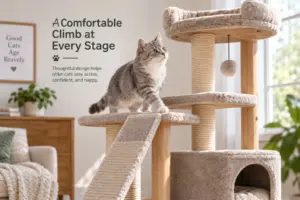
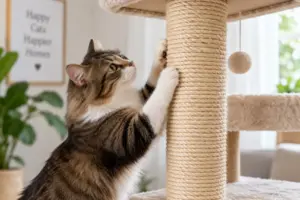
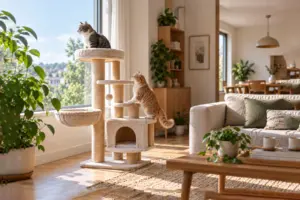
For brands and product buyers, the best cat trees for large cats are not simply the tallest models or the ones with the highest advertised weight capacity. The strongest products combine genuinely usable resting space, stable support, appropriate component capacity, and a layout designed around a larger cat’s body and movement.
Labels such as “XL,” “XXL,” “heavy duty,” and “for Maine Coons” do not prove that a product meets those requirements. A large overall footprint can still contain undersized perches, while a high total weight-capacity claim may say little about the platform or hammock the cat actually uses.
For buyers sourcing or developing this category, the practical test is simple: evaluate the parts the cat uses and how those parts work together—not the size claims on the product listing.
Reject “Large” Designs With Small Usable Components
Overall dimensions tell a buyer how much space an assembled cat tree occupies. They do not tell you whether a large cat actually fits.
Cats interact with individual components: top perches, platforms, hammocks, enclosed houses, scratching areas, and the transitions between them. A 70-inch cat tree can therefore be tall without offering much usable space for a large cat.
This is especially important when evaluating products marketed as a Maine Coon cat tree, XXL cat tree, or extra large cat tree.
A top bed should provide enough usable area for the intended cat to settle naturally. A platform needs to remain useful after posts, raised edges, and adjacent components take up part of its nominal dimensions. For an enclosed house, both the entrance and internal space matter.
This is why product specifications should distinguish between overall product dimensions and the dimensions of important occupied components.
The same principle applies during development. Simply increasing overall height or adding a larger base does not turn an existing model into a genuine cat tree for large cats.
Do not scale the marketing claim before you scale the parts the cat actually uses.
For a product buyer, this creates the first screening criterion: if the important resting and movement areas remain small, the product should not move forward simply because the catalog calls it “large.”
Compare Stability Under Use, Not Just Product Weight
A cat tree is normally photographed standing still. A large cat does not use it that way.
It jumps onto upper platforms, pulls against scratching posts, turns on perches, climbs between levels, and launches off the structure. The product therefore needs to remain stable during movement, not merely support static weight.
A heavy base can help, but product weight alone is a poor substitute for evaluating the complete structure.
Look at where upper platforms are supported, how far occupied areas extend beyond their nearest support, whether large platforms depend heavily on a single connection, and how the upper structure transfers load toward the base.
Two cat trees can have similar height, board thickness, and assembled weight yet behave differently because their geometry and support arrangements are different.
Stability problems are also not always obvious on a specification sheet. They become much easier to identify once a sample is assembled and movement is introduced.
For buyers evaluating a sample, one practical question is:
What happens when a large cat moves through the upper half of the tree?
If the upper structure develops excessive movement, connections begin to loosen, or large occupied platforms feel poorly supported, a substantial-looking product may still be a weak candidate for the category.
This is why cat tree stability should eventually be evaluated at the assembled-product level, rather than inferred from one material or dimensional specification.
Weight Capacity Is a Filter, Not the Whole Decision
A large cat tree needs sufficient load capacity, but the number only becomes useful when the buyer understands what it describes.
A published rating might refer to an individual perch, a platform, a hammock, the complete cat tree, or a recommended maximum cat weight. Those are not interchangeable specifications.
For example, if a product line is intended for cats around 20 lb, the buyer needs to know whether the components those cats actually occupy are suitable for that use. If multiple cats may share the same platform or hammock, that shared use also needs to be considered.
A high total capacity does not automatically answer either question.
That is why cat tree weight capacity should be treated as one screening criterion rather than proof that a product is suitable for large cats.
The development sequence matters as well.
The intended cat size and use case should come first. Platform dimensions, support arrangement, materials, joints, and other structural decisions can then be developed around those requirements before the resulting capacity is validated.
In other words:
Weight capacity should be the result of product development and validation, not a marketing number chosen at the beginning of the process.
For sourcing teams, a clearly defined component rating backed by meaningful product information is more useful than an unexplained “heavy duty” claim.
Check Whether the Layout Still Works After the Components Get Larger
Designing for large cats involves more than enlarging individual platforms.
Those larger components still have to work together.
A larger cat occupies more space when resting, turning, landing, and moving between levels. Increasing the dimensions of one platform without reconsidering the surrounding structure can block access, reduce usable space elsewhere, or create an awkward transition to the next level.
When reviewing a drawing, rendering, or physical sample, imagine the cat moving through the tree rather than posing on the product photo.
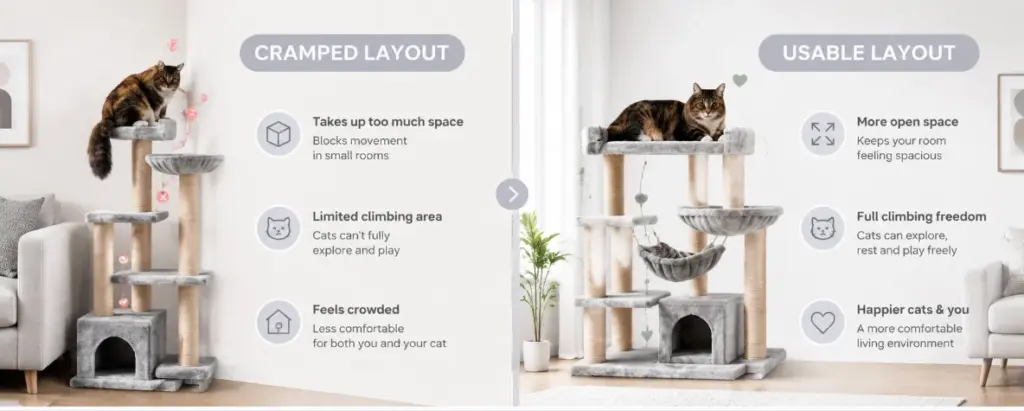
Can a large cat move between the main levels without squeezing through an unnecessarily narrow route? Is there enough usable landing area at the next level? Can it turn around on the important platforms? If one large cat occupies the top perch, can another still use the surrounding structure?
These questions become even more important when developing a cat tree for multiple large cats. More platforms do not necessarily mean more usable capacity if several cannot be comfortably occupied at the same time.
Published products provide useful benchmarks, provided their specifications are not treated as universal standards. For example, Globlazer’s F83 large-cat model uses a 55 × 45 cm upper platform within a 213 cm-tall structure and describes multiple support points and a trapezoidal arrangement. Those numbers do not define the correct dimensions for every large-cat product. They demonstrate something more useful: when occupied areas become larger, their relationship with the surrounding support structure also has to be considered.
That changes the development question from:
“What platform size should we copy for a large-cat tree?”
to:
“How much usable space does our target cat need, and what does the structure need to become once we provide it?”
That is a much stronger basis for developing a differentiated product rather than simply enlarging an existing SKU.
How Should a Buyer Compare Cat Trees for Large Cats?
When several products all claim to be suitable for large cats, the fastest way to narrow the options is to replace marketing claims with product questions.
| Don’t Compare Only | Ask Instead |
|---|---|
| Overall height | Are the actual perches, beds, and platforms large enough? |
| “Heavy duty” label | How are the main occupied areas supported? |
| Total weight capacity | What component or use case does the rating actually apply to? |
| Number of levels | Can a large cat move comfortably between them? |
| Thick-looking posts | Are the supports positioned where they are structurally useful? |
| Extra features | Does the core structure work before additional features are considered? |
For sourcing an existing model, the sequence should therefore be:
Fit → Stability → Component Capacity → Layout → Construction → Features and Appearance
For developing a new model, the logic goes one step further:
Target Cat and Use Case → Usable Dimensions → Layout → Structural Support → Materials and Construction → Validation
This distinction matters. The first process helps a buyer identify the strongest existing candidate. The second turns a market requirement such as “we need a better cat tree for large cats” into specifications a factory can actually work with.
The best cat tree for large cats is ultimately one whose usable spaces fit the intended animal, whose occupied areas are properly supported, whose capacity matches real use, and whose layout continues to work when a large cat climbs, rests, turns, and moves through the structure.
For product development, the principle is straightforward:
Design around the cat’s body and behavior first. The “large cat” label should come afterward.
That is also how Sympet Living approaches cat furniture development: define the target user and use case first, then translate those requirements into dimensions, structure, materials, manufacturing decisions, and validation—instead of simply enlarging an existing product and calling it XXL.