Choosing a cat tree for large cats is not simply a matter of buying a bigger or taller version of a standard cat tree.
Larger cats need more room to turn, land, stretch, scratch, and rest. Their movement also places different demands on platforms, posts, joints, and the base of the structure. A tree can look substantial in a product photo and still feel cramped or unstable once a large cat starts using it.
This is why specifications such as overall height, platform size, or advertised weight capacity are useful—but none of them should be evaluated alone.
A better approach is to look at the cat tree as a complete system:
Is it stable?
Is the space genuinely usable?
Can the cat move through it comfortably?
And does the construction make sense for the way the tree will actually be used?
Those questions reveal much more than a “large cat” label.
1. Start With the Whole Structure, Not One Specification
For a large cat, stability should be one of the first things you consider.
A larger base can help resist tipping, but base size alone does not determine whether a cat tree will feel stable. Height, post position, upper-platform placement, connections, and weight distribution all affect how the structure behaves.
Consider a large top perch extending well beyond its supporting post. When a heavy cat lands near the outside edge, the load is no longer acting directly over the support. That creates leverage on the post, joint, and structure below.
Moving the support closer to the loaded area can change that behavior substantially—even if the overall dimensions and materials remain the same.
Posts work in a similar way. They may serve as scratching surfaces, but many are also structural members connecting one level to another. Their diameter matters, but so do their length, position, attachment points, and what they are supporting.
Connections matter because movement can travel through the structure. A small amount of looseness near the bottom of a tall tree may become much more noticeable at the upper levels.
This is why cat tree stability is better understood as a structural relationship than as a single feature.
The same caution applies to cat tree weight capacity.
A cat sitting quietly on a platform creates a different load from a cat jumping onto its edge. Real use includes landing, climbing, scratching, turning, and lateral movement. With multiple cats, several parts of the structure may also be loaded simultaneously.
So an advertised weight rating can be useful, but it should not replace looking at how the loaded areas are actually supported.
For tall designs, wall anchoring can provide additional anti-tip protection. It should be treated as an additional safety measure, however, rather than a substitute for sensible structural design.
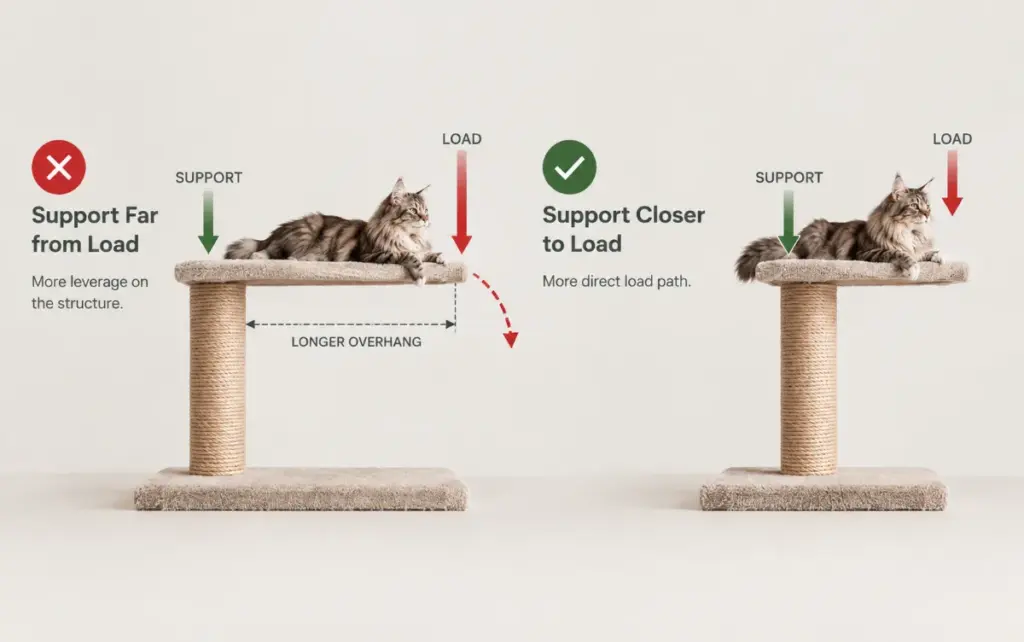
The practical takeaway is simple:
Don’t ask only how much weight the cat tree can hold. Ask how the structure supports that weight when the cat is moving.
2. Usable Space Matters More Than Overall Size
A large cat tree is not necessarily a cat tree with a lot of usable space.
Overall width, depth, and height describe the outside dimensions of the product. They do not tell you how much room the cat actually has to land, turn, sleep, or move between levels.
Platforms are a good example.
A platform may appear wide on a specification sheet, but a post passing through the surface reduces the available resting area. Raised edges, neighboring posts, cushions, and unusual platform shapes can reduce it further.
The same applies to enclosed houses. Exterior dimensions do not tell you the entrance size or the usable interior space.
When comparing cat trees for big cats, pay particular attention to:
- top perches and resting platforms;
- landing areas between levels;
- condo entrances and interior dimensions;
- hammock size and support;
- obstructions that reduce usable surface area.
Not every platform needs to be large. A smaller level may function primarily as a step. A top perch intended for sleeping has a different job and should provide enough room for the cat to turn and settle.
This distinction becomes especially important with products marketed as a Maine Coon cat tree, XXL cat tree, or extra-large cat tree. A large exterior silhouette does not automatically mean the important areas are proportioned for a large body.
Understanding the right cat tree size and platform dimensions therefore requires looking beyond the product’s overall footprint.
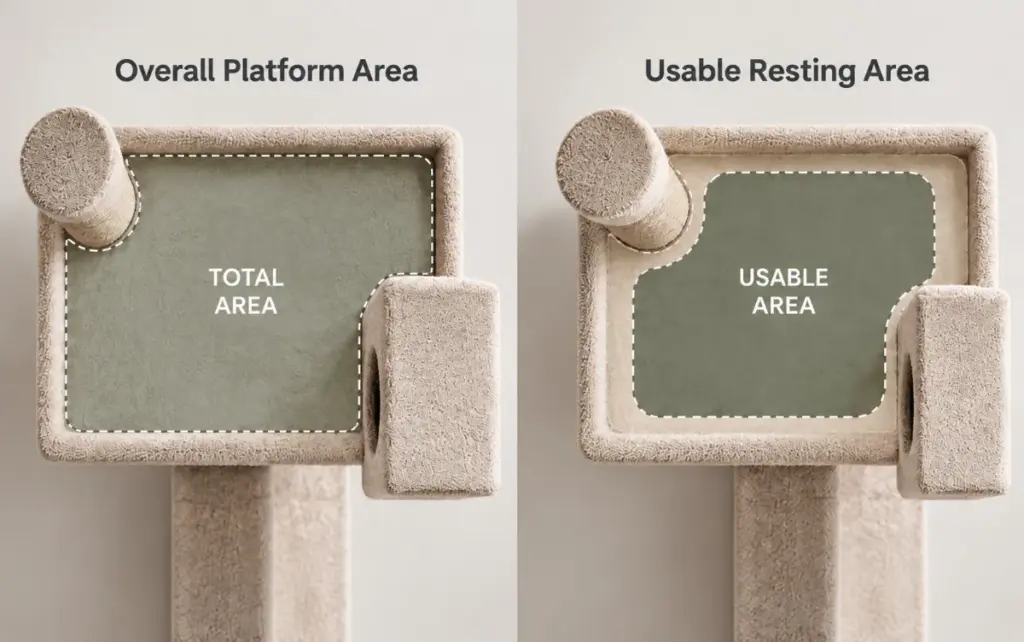
A useful test when viewing a product is:
Where will the cat actually put its body?
That question often tells you more than the overall dimensions.
3. Check Whether the Layout Works for a Large Body
Once the individual spaces look large enough, look at how they connect.
A cat tree can contain many platforms, hammocks, houses, ladders, and perches while still being awkward for a large cat to use.
Follow the route through the tree as if you were the cat.
Where does it first jump onto the structure? Where does it place its body before moving upward? Is there a practical landing area beneath the top perch? Does it need to squeeze around a post or make an awkward turn to reach another level?
For a large cat, these transitions matter.
A top perch may be spacious but difficult to reach. A hammock may look generous but occupy the only practical route between two levels. A condo can add visual complexity while leaving too little room around it for comfortable movement.
This is one reason feature count is a poor measure of cat-tree quality.
More platforms do not necessarily create more useful space.
In many cases, a simpler arrangement with clear movement routes and properly proportioned resting areas can work better than a crowded design with many undersized features.
The same principle becomes even more important when choosing a cat tree for multiple large cats.
Instead of simply looking for more features, consider whether several useful areas can be occupied at the same time. One cat may be resting on the top perch while another scratches a lower post or uses an enclosed space.
If every route passes through one small platform, or if only one resting area is genuinely comfortable, a physically large tree may still function like a single-cat product.
For multiple cats, usable territory matters more than feature count.
4. Materials Matter, but Construction Matters More
Material descriptions can strongly influence how buyers perceive a cat tree.
Solid wood may sound inherently better than engineered panels. A thicker post may sound stronger than a thinner one. A heavier product may appear more stable.
In practice, these characteristics need context.
The materials used in a cat tree perform different jobs. Panels form bases, platforms, and houses. Posts connect levels and provide scratching surfaces. Sisal, plush, fabric, and other coverings affect scratching, comfort, appearance, and durability.
For structural components, the way the material is used can be just as important as the material name.
A panel’s dimensions, thickness, unsupported span, hole positions, and support locations all influence how it performs. A post’s behavior depends not only on its core material or diameter, but also on its length, location, connection method, and the platform above it.
This is why comparing a wooden cat tree with one made from engineered panels should not be reduced to “solid wood is good” and “particle board is bad.”
A well-designed engineered-panel structure can make sense for many cat-tree applications, while an expensive material cannot compensate for poor geometry or weak connections.
Surface materials should also be judged according to their function. Sisal is commonly used where cats scratch; plush and fabrics may be used where comfort and appearance matter. The right choice depends on what that part of the product is supposed to do.
For large cats in particular, material selection and structural design should be evaluated together.
The better question is not:
“What is this cat tree made from?”
but:
“Does the material and construction make sense for this component and the load it carries?”
That distinction is especially useful when comparing products that look similar but are built differently.
5. How to Evaluate a Cat Tree for Large Cats
When comparing products, avoid searching for one specification that proves a cat tree is suitable for a large cat.
Instead, work through the product as a system.
| Check | What to Look For |
|---|---|
| Stability | The tree remains reasonably steady during climbing, landing, and scratching |
| Base & support | The footprint and support positions make sense relative to the height and upper structure |
| Platforms | Enough usable room for landing, turning, sitting, and resting |
| Connections | Posts, panels, and joints work together without obvious unwanted movement |
| Layout | The cat can move naturally between levels |
| Resting areas | Perches, houses, and hammocks provide genuinely usable space |
| Scratching areas | Suitable surfaces are positioned where the cat can use them comfortably |
| Multiple-cat use | More than one useful area can be occupied without creating obvious bottlenecks |
| Materials | Materials and construction methods suit the function of each component |
| Anchoring | Appropriate additional anti-tip support is available where needed |
The best cat tree for large cats is therefore not necessarily the tallest, heaviest, or the product with the highest advertised weight capacity.
It is the one where structure, usable space, layout, and construction work together for the size and behavior of the cat using it.
That same principle applies when developing a cat tree rather than buying an existing one.
Increasing a platform size, moving a post, adding height, or enlarging a top perch may appear to be a simple customization. But each change can alter load distribution, movement routes, packaging, component dimensions, or the way other parts of the structure need to be supported.
This is why we approach cat furniture development as a complete product rather than a collection of isolated dimensions.
For pet brands developing large-cat furniture, Sympet Living can work from an existing product reference, requested modifications, or a new design direction through sampling and manufacturing.
[RELATED_PRODUCT]
You can also start a custom cat furniture project with us if you are evaluating a new design or modifying an existing product for larger cats.