here is no single weight capacity that every cat tree should meet.
If your cat weighs 18 lb, the first thing to check is not whether the entire cat tree is advertised to hold more than 18 lb. What matters more is whether the platform, perch, hammock, or other component your cat will actually use is designed for that load.
The same applies to a multi-cat household. If two cats are likely to share one hammock or platform, that component needs to be suitable for their combined use. A high total weight capacity for the entire tree does not necessarily tell you that.
That is why a simple rule such as “buy a cat tree rated for twice your cat’s weight” is not particularly useful unless the manufacturer clearly explains what the rating applies to and how it was established.
A better approach is to answer two questions:
How much weight will the part my cat actually uses need to support, and does the product give me enough information to trust that rating?
Once you look at weight capacity this way, comparing cat trees becomes much easier.
How Much Weight Capacity Does Your Cat Actually Need?
Start with your cat’s actual weight and how the tree is likely to be used.
For one cat, each platform, perch, hammock, or enclosed level it regularly occupies should be explicitly suitable for that cat’s weight. If your cat weighs 18 lb, for example, a 100 lb total-tree capacity is less useful than knowing whether the top perch your cat sleeps on is intended to support an 18 lb cat.
For multiple cats, think about where they may be at the same time.
If a 12 lb cat and a 14 lb cat regularly share the same hammock, that hammock may need to support roughly 26 lb of combined cat weight. If the two cats normally use separate platforms, however, simply adding their weights together and comparing the result with one total-tree capacity number does not tell you much about either platform.
This distinction becomes particularly important with larger breeds.
A heavy cat needs adequate structural support, but it also needs enough physical space to use the furniture comfortably. A platform might be strong enough to support a 20 lb cat while still being too small for that cat to turn around, stretch out, or settle comfortably.
That is why choosing a cat tree for large cats involves more than finding the largest capacity number on a product page. Weight, usable platform size, layout, access, and overall stability all need to work together.
The practical rule is simple:
Evaluate the load where the cat will actually be—not just the advertised capacity of the entire tree.
What Does a Cat Tree Weight Capacity Actually Mean?
Before comparing weight ratings, check what each number refers to.
A manufacturer might publish a capacity for:
- an individual platform;
- a top perch;
- a hammock;
- a recommended maximum cat weight; or
- the complete assembled cat tree.
These are not interchangeable specifications.
Suppose a five-level cat tree is advertised with a total capacity of 100 lb. That does not necessarily mean the top perch can support 100 lb.
The total figure may assume that several cats are distributed across different parts of the structure. If two cats climb into the same hammock, the relevant specification is the capacity of that hammock and its connections—not the combined capacity of every platform elsewhere on the tree.
This is why a large capacity number is much more useful when the manufacturer explains what has actually been rated.
There is another distinction worth understanding: a rated capacity is not necessarily the same thing as the point at which a component physically breaks.
Structural problems can appear before catastrophic failure. A platform may flex excessively. A joint may begin to move. Hardware may loosen over repeated use, or movement from an upper platform may transfer into the supporting posts.
For consumers, there is no reason to experiment with these limits. Treat the manufacturer’s stated capacity as a limit, not as a challenge to find the product’s actual breaking point.
If a product simply says:
Weight Capacity: 100 lb
without explaining what that number applies to, you have less useful information than you would from clearly defined component ratings.
Why Can Two Cat Trees With the Same Weight Rating Perform Differently?
Imagine the same 20 lb cat sitting in two positions on the same type of platform.
In the first case, the cat is close to the supporting post.
In the second, the cat moves toward the unsupported outer edge.
The cat has not become heavier, but the structural demand has changed.
As the load moves farther from its support, it creates more leverage on the platform, its connection, and the supporting structure below it. This is why platform size alone does not tell you how well a platform is supported.
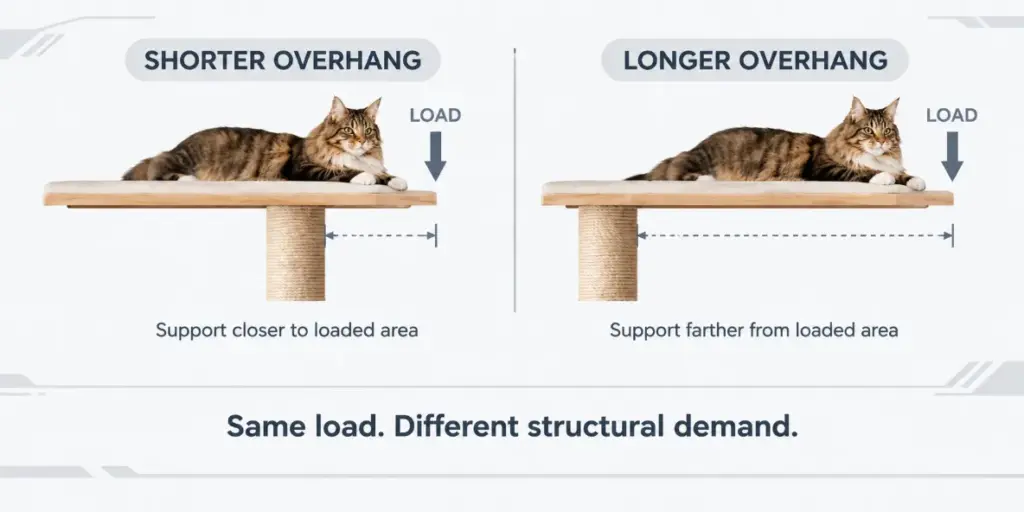
This relationship also helps explain why manufacturers change more than one specification when designing cat furniture for larger cats.
As one external manufacturing example, Globlazer’s F83 is a large cat tree measuring 83 inches (213 cm) tall and weighing 20.7 kg. Its published design includes a 55 × 45 cm upper platform, a trapezoidal arrangement, and multiple support points.
Another large-cat model from the same manufacturer, the S67, specifies 110 mm support posts, a reinforced base, and an anti-tip restraint.
Those numbers are not universal standards. A cat tree does not automatically become suitable for a large cat because it uses a 110 mm post or a particular platform dimension.
The useful lesson is simpler:
When the intended use becomes more demanding, manufacturers can change the geometry, support arrangement, and dimensions of the actual structure—not merely increase the number printed next to “weight capacity.”
This is also why “stronger material” is not a complete answer. A better panel cannot fully compensate for an unnecessarily long unsupported platform, and a thicker post cannot correct every poorly positioned support.
Weight capacity is ultimately a property of the assembled structure.
What Should You Check Beyond the Weight-Capacity Number?
When comparing cat trees, start by asking what the capacity applies to.
If the product gives individual ratings for the perch, hammock, or platforms your cat will use, those figures are more useful than an unexplained total capacity.
Next, look at how the occupied areas are supported.
You do not need to calculate loads or understand structural engineering to make a basic visual assessment. Look at where the posts sit beneath larger platforms, how far occupied areas extend beyond their supports, and whether large upper platforms rely on one connection or several.
Then consider whether the platform is actually large enough for the cat.
This is particularly important for large breeds. Strong enough and large enough are two different questions. A platform can meet its stated load rating and still provide poor usable space.
Construction details can provide additional context.
For example, manufacturers may specify post dimensions, board properties, hardware, or structural arrangements rather than simply describing a product as “heavy duty.” Globlazer publicly reports particleboard density of approximately 650–670 kg/m³ and an elastic modulus of 2300+ for its custom board, while the F83 product specification identifies M8 hardware.
These figures should not be treated as minimum requirements for every cat tree. Their value is that they turn vague claims such as “high-quality board” or “strong hardware” into specifications that can actually be examined.
Finally, look for evidence behind the capacity claim.
Clearly defined component limits, material specifications, structural information, and documented testing all provide more context than a large capacity number on its own.
So, how much weight should a cat tree hold?
It should be explicitly suitable for the weight of the cat or cats expected to use each load-bearing component. For one cat, check the components that cat will actually occupy. If multiple cats may share a perch or hammock, consider their combined use on that component rather than relying only on the total capacity of the whole tree.
Then look beyond the number itself.
Ask what has been rated, how the occupied area is supported, whether it provides enough usable space, and what evidence the manufacturer provides for the claim.
From a product-development perspective, this is why weight capacity should not begin as an attractive number for a specification sheet.
The intended cat size and use case should come first. Those requirements inform platform dimensions, support arrangement, materials, joints, and overall structure. The resulting product can then be prototyped and validated before a defensible capacity claim is established.
Weight capacity should be an output of product development—not an input from marketing.
That is the approach Sympet Living applies to cat furniture development: treating intended use, dimensions, materials, and structure as connected product decisions rather than isolated specifications.