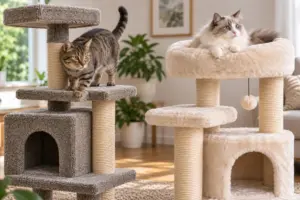
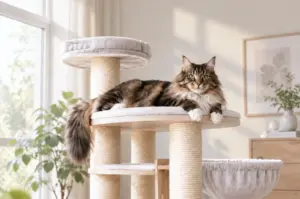
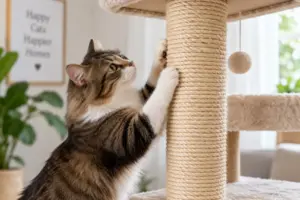
The best place for a cat tree is usually somewhere your cat already wants to spend time, with a layout that supports how the cat is expected to approach, climb, rest, and leave the structure. A good location combines visibility, comfort, accessibility, and a good fit between the cat tree and the surrounding space.
That does not mean every cat tree needs a large open area around it.
A compact floor-to-ceiling cat tree may work very well in a small space because it is designed around vertical movement and a small footprint. A large freestanding tree, on the other hand, can be poorly placed if nearby furniture blocks the routes the cat needs to use it.
A well-designed cat tree can still be ignored if its location does not match the cat’s daily habits or the way the product was designed to be used. Many placement problems are therefore not simply product problems or space problems. They come from a mismatch between the cat, the product, and the environment.
Instead of asking only:
“Where do I have space for a cat tree?”
A better question is:
“Where will this cat tree fit naturally into the way my cat uses the room?”
Put the Cat Tree Where Your Cat Already Wants to Be
One of the most common mistakes is placing a cat tree based only on human convenience.
A corner may look perfect from a room-layout perspective, but if the cat rarely spends time there, the structure may receive little attention.
Before choosing a location, observe your cat’s existing habits.
Where does your cat usually:
- watch people or other animals?
- sleep during the day?
- look outside?
- rest after playing?
- move through the home?
These behaviors provide useful clues about where a cat tree is likely to become part of the cat’s routine.
Cats often prefer locations that allow them to stay connected with their environment. A cat tree in a frequently used area may therefore be more attractive than one hidden away simply because that corner happens to be empty.
This does not mean the busiest part of the room is always best. The goal is to find a location that offers something the cat already values—observation, rest, climbing, scratching, or proximity to household activity.
The placement decision should begin with behavior, not available floor space.
Use Windows and Social Areas Strategically
Windows and shared living areas are two common locations worth considering.
A window can provide visual stimulation and an elevated observation point. Many cats enjoy watching outdoor movement and activity from inside the home.
But a window is not automatically the best location.
Consider:
- whether direct sunlight makes the area uncomfortable;
- whether there are strong drafts;
- whether the cat already spends time near that window;
- whether the surrounding layout supports comfortable access and movement.
Shared living areas can offer a different advantage.
Some cats prefer being near household activity without remaining directly involved in it. An elevated platform in a living room can allow a cat to observe people while maintaining its own space.
From a product-development perspective, this follows a simple sequence:
Cat Behavior → Environment Need → Placement
A cat that likes observing needs visibility.
A cat that spends long periods resting needs a comfortable and secure location.
A cat that actively climbs needs a placement that preserves the movement routes built into the product.
The best location is therefore not defined by one room. It is defined by how well that location supports the behavior the cat is expected to perform there.
Make Sure the Placement Fits the Cat Tree’s Movement Route
A cat tree does not necessarily need a large amount of empty space around it.
What matters is whether the placement preserves the movement routes the design is intended to provide.
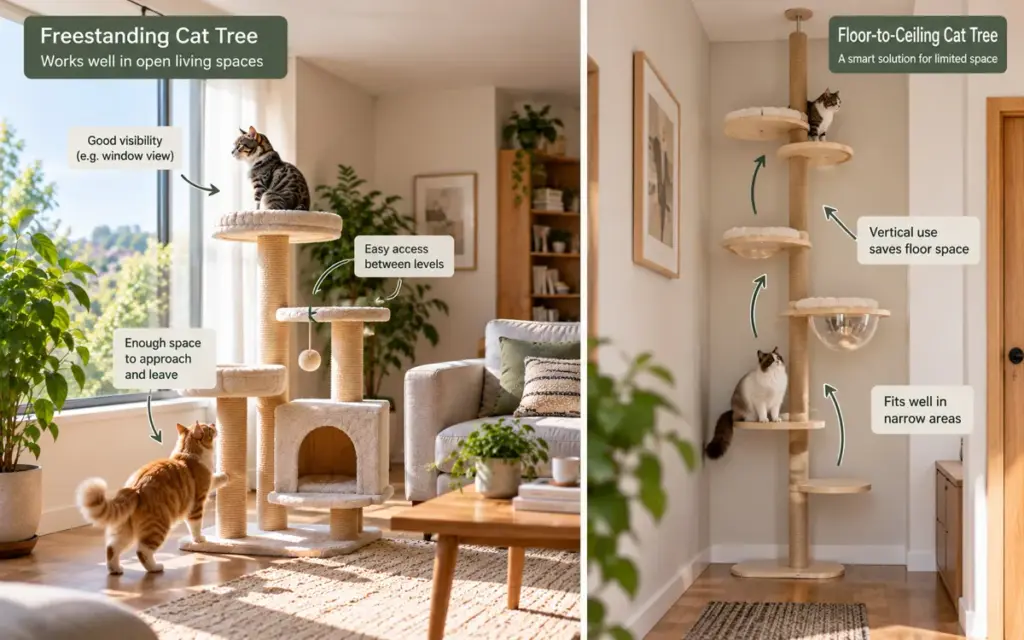
Cats may approach a tree, step or jump onto the first level, transition between platforms, turn around, enter a house or hammock, reach the highest perch, and leave the structure in different ways.
The room should allow those movements to happen as intended.
Freestanding Cat Trees
For a conventional freestanding cat tree, surrounding furniture can change how usable the structure feels.
A large tree may physically fit between a sofa and a cabinet, for example, while still leaving an awkward approach to its lower platforms or blocking a natural jump route.
The question is not simply whether the base fits on the floor.
Look at whether the cat can comfortably:
- approach the intended entry points;
- use the lower and upper platforms;
- transition between levels;
- turn or reposition;
- enter and leave without unnecessary obstruction.
A larger room does not automatically produce better placement if the product is positioned badly within it.
Floor-to-Ceiling and Compact Vertical Cat Trees
A compact space can work very differently when the product is designed specifically for it.
Floor-to-ceiling cat trees and other vertical designs can use a relatively small footprint while providing climbing and resting space upward rather than outward.
In this case, being close to a wall or occupying a narrow floor area is not necessarily a disadvantage. The product may have been designed around exactly that condition.
The important questions change.
The placement needs to suit the intended fixing or support system, preserve the vertical climbing route, and provide usable access to the platforms rather than simply maximizing open floor area.
This distinction matters because good placement is not about creating as much empty space as possible.
Good placement is about matching the product’s structure to the way the cat is expected to move through it.
From a product-development perspective, the relationship can also work in the opposite direction.
If a cat tree is being developed for a specific environment, the available space can become an input to the design itself.
For example, cat furniture intended for a compact apartment may use a smaller footprint, a more vertical platform arrangement, or a floor-to-ceiling support system. A freestanding design for a larger living area may instead use a broader base, wider resting platforms, or a more open climbing layout.
For custom cat furniture, factors such as available floor area, ceiling height, intended location, cat size, and expected movement can therefore help define the product before the final structure is developed.
The logic becomes:
Use Environment → Cat Behavior → Product Requirements → Structure
Placement is no longer something considered only after the cat tree has been purchased. It can also be part of the product-development brief.
Consider Your Cat’s Lifestyle and Household Setup
Even with the right product type, the ideal location still depends on the cat using it.
Active Cats
Active cats may benefit from a location where the cat tree becomes part of an existing movement route.
If the cat regularly moves between particular parts of the room, a climbing structure positioned within that environment may be more useful than one isolated from normal activity.
Older Cats
Older cats may benefit from locations that make access simpler.
A comfortable upper resting area has limited value if reaching the first level already requires a difficult movement. The location and surrounding furniture should not make an accessible product unnecessarily difficult to use.
Our guide to choosing a cat tree for older cats looks more closely at accessibility, transitions, resting areas, and structure for senior cats.
Multi-Cat Homes
In a multi-cat home, placement can also affect how cats share the structure.
Consider whether cats have practical ways to approach and leave, whether useful resting areas are available at different levels, and whether the location creates an unnecessary bottleneck.
Again, there is no single room or position that works for every household.
The objective is to match the location to the cats, the structure, and the way the space is actually used.
Use This Checklist Before Choosing a Location
Before deciding where a cat tree should go, evaluate the location from both the cat’s perspective and the product’s.
| Check | Question |
|---|---|
| Behavior | Does your cat already spend time or show interest in this area? |
| Visibility | Does the location provide the observation or privacy your cat prefers? |
| Access | Can the cat comfortably reach the intended entry points? |
| Movement Route | Can the cat use the platforms and transitions as the design intends? |
| Comfort | Is the location suitable for resting for longer periods? |
| Product Fit | Does the space suit a freestanding, compact, or floor-to-ceiling design? |
The best place for a cat tree is not necessarily the largest empty space in the home.
It is a location where the cat’s behavior, the room, and the structure work together.
Sometimes that means a freestanding tree with comfortable space around its main movement routes. Sometimes it means a compact vertical tree designed specifically to make better use of limited floor space.
Understanding that difference makes placement a product decision rather than simply a furniture-arrangement decision.
If you are still deciding which structure fits your cat and your home, our guide to best cat trees explains the broader factors to compare before choosing one.