In practical factory evaluation, a new cat tree is typically checked in stages: static loading of key platforms, push-and-sway testing of the assembled structure, inspection for deformation or loosened connections, and additional repeated or impact loading when the design requires it.
No single test number determines cat tree stability. A platform can support its intended load while the complete structure still moves excessively, and a cat tree that feels stable when first assembled can develop movement after repeated use.
In the cat-furniture factory we work with, a typical starting reference for sample evaluation is to test key load-bearing components at 1.5 times their intended working load. The result is then judged not only by whether the component survives the load, but also by what happens to the structure during the test and after the load is removed.
For buyers, the useful question is therefore not simply:
“Did this cat tree pass a stability test?”
It is:
What was tested, how was it tested, and what happened to the structure afterward?
How Our Factory Evaluates a New Cat Tree Sample
For a new cat tree, one of the first structural checks is usually a static load test on the components expected to support the cat.
The method does not need to be complicated. The factory may use weights, sandbags, or other suitable loads that can be distributed across the platform without creating an unrealistic point load.
For routine sample evaluation, our factory normally starts at approximately 1.5 times the intended component load. A platform intended to support 10 kg, for example, would typically be tested with approximately 15 kg.
Routine samples and production spot checks may remain loaded for around four hours, while important new designs or samples for more demanding customer projects may be held for 8 to 24 hours.
These figures are factory working references used in practical sample evaluation, not universal cat-tree testing requirements. The appropriate method can change with the product structure, intended use, customer specification, and level of validation required.
The test also does not finish when the weight comes off.
The component is inspected again for:
- permanent sagging or warping;
- cracks or unusual sounds from the board;
- loosened screws or connectors;
- movement around the supporting post or joint;
- visible changes in alignment.
As a practical workshop reference, permanent deformation of roughly 3 mm or more after unloading would normally trigger further review rather than automatic approval.
The important distinction is that supporting a load during the test and returning from that load without unacceptable structural change are not the same thing.
A platform that does not break can still be a poor result if the board remains noticeably deformed or the connection becomes loose afterward.
Stability Is Tested Differently From Weight Capacity
Static loading answers an important question:
Can this component support the intended load without unacceptable damage or permanent change?
It does not answer another:
What happens when a cat moves across the assembled structure?
Cats do not behave like static test weights. They climb, scratch, change direction, jump onto platforms, and launch themselves from elevated positions.
That is why cat tree weight capacity and whole-product stability need to be evaluated separately.
For taller samples—particularly cat trees around 1.5 meters and above—the factory normally places the fully assembled product on a hard, level floor and checks movement from the upper usable areas.
The process is deliberately practical.
The upper platform or upper section is pushed from side to side and from front to back. The structure may be lightly shaken, and weight may sometimes be added to an upper platform before the movement check.
The person evaluating the sample watches where the movement begins.
Does the entire base move?
Does one edge of the base begin to lift?
Does the base remain stationary while the upper structure sways?
Does one platform move around its connection?
Do the joints remain tight after the movement stops?
These observations are more useful than simply describing a sample as “a little wobbly.” They help identify whether a revision should focus on the base, support position, platform geometry, connection, or another structural variable.
For some taller or higher-requirement projects, the factory may use a more demanding lateral check at an upper usable platform. But Sympet does not treat one horizontal-force number as a universal requirement for every cat tree. The same force applied at different heights and to different structures does not create the same structural condition.
Where appropriate, tall designs may also include an anti-tip restraint or wall-fixing component. This adds another layer of protection, but it does not eliminate the need to evaluate the underlying structure.
What Happens After the First Load and Push Test?
A sample can perform well during its first static check and still develop problems after repeated movement.
This is particularly relevant for new structures, unfamiliar connection designs, tall cat trees, or products being developed for customers with more demanding requirements.
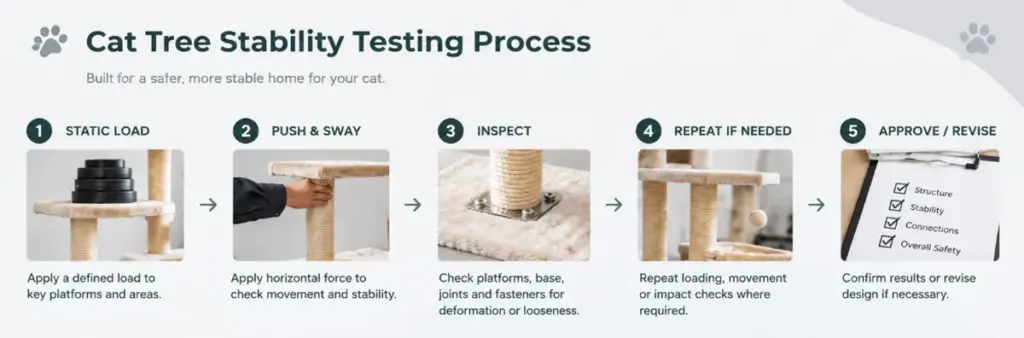
In those cases, the factory may extend the evaluation beyond a single static test.
A platform can be repeatedly loaded and unloaded dozens or hundreds of times. Selected development samples may receive repeated impact from a sandbag to approximate the short-duration loading that occurs when a cat lands on a platform. Taller structures may also be moved repeatedly from side to side.
Afterward, the product is inspected again for:
- screws or other fasteners that have loosened;
- connections that have developed additional play;
- platforms that have shifted or deformed;
- posts that have moved from their original position;
- changes in how the complete structure behaves.
These workshop checks should not be confused with a full laboratory fatigue-testing program.
Thousands of controlled load cycles may be appropriate during development or when a particular customer specification requires them, but they are not necessarily performed on every production unit. Routine production inspection is more likely to combine static loading, assembly checks, practical movement checks, and post-test inspection.
The level of validation should match the product and the project.
A relatively low, simple scratching structure does not necessarily need the same evaluation as a tall multi-level tower intended for large, active cats.
Why Stability Testing Varies Across the Cat Tree Industry
There is no single test method universally used by every cat tree manufacturer.
Factories may use their own internal procedures, while importers and retailers may add customer-specific inspection requirements. Routine products may receive static load and practical movement checks, while more demanding projects can involve repeated loading, impact evaluation, anti-tip checks, or additional third-party testing.
Some manufacturers also borrow testing concepts from established furniture categories. That can be useful: furniture testing already addresses issues such as tipping, structural loading, connections, and repeated use.
But there is an important distinction:
Borrowing a test principle and claiming compliance with an unrelated standard are two different things.
For example, ASTM F2057 is sometimes referenced online in discussions of furniture tip-over testing. ASTM defines F2057 around the stability of clothing storage units; it is not a dedicated cat-tree stability standard.
A manufacturer may adapt a useful test principle from another furniture category without that making the resulting cat tree compliant with that standard.
The same caution applies to impressive-looking load figures.
“Tested to 30 kg” has limited value unless the supplier can explain where the load was applied, how long it remained there, which product configuration was tested, and what constituted an acceptable result.
Method before number. Evidence before claim.
What Should a Buyer Ask to See Before Approving a Sample?
Buyers do not necessarily need a laboratory report for every cat tree they source.
They do need enough information to understand what the factory has actually validated.
For a new sample, useful questions include:
- What working load was assumed for the major occupied components?
- What load was actually applied during evaluation?
- Where was the load positioned, and for how long?
- What was checked after the load was removed?
- How was lateral movement or tipping tendency evaluated?
- Did any part of the base lift during the check?
- Did platforms, posts, screws, or other connections loosen?
- Were repeated loading or impact checks appropriate for this design?
- If the structure was revised, was the affected area tested again?
- Does the production specification still match the approved sample?
The objective is traceability rather than paperwork for its own sake.
If a sample fails, the useful outcome is not simply a failed inspection. The development team should be able to identify what failed, under what condition, what was changed, and whether the revised product corrected the problem.
That creates a practical development loop:
Intended Use → Working Load → Sample → Load & Stability Checks → Inspection → Revision → Retest → Production Approval
A credible stability evaluation is therefore not the one with the largest test number. It is one that reflects the intended product, uses a repeatable method, and shows what happened to the structure during and after the test.
At Sympet Living, the practical load, movement, and post-test checks used by our cat-furniture manufacturing partners provide the starting point. From there, the evaluation can be adjusted for product height, structure, intended cat, retailer requirements, or a customer’s own specification.
That is how stability becomes part of cat furniture product development rather than a marketing claim.