Sisal is one of the most common scratching materials used on cat trees, but seeing “natural sisal” in a product description does not tell you how durable the scratching surface will be.
From a manufacturing perspective, the rope itself is only one part of the result. Fiber quality, rope diameter, winding tension, and the way the rope is fixed to the post all affect how the surface holds up after repeated scratching. A well-made 8 mm sisal wrap can perform better than a poorly made 10 mm one.
For buyers, the practical lesson is simple: do not judge a sisal cat tree by rope thickness alone. Look at the quality of the rope, how tightly it is wrapped, and whether it remains securely fixed to the post.
Not All Sisal Rope Is the Same
Two cat trees can both use natural sisal and still have very different scratching surfaces.
When we source sisal rope for cat-tree production, one of the first things we look at is how tightly and consistently the fibers are twisted. Better rope tends to have a firm three-strand twist, a relatively even surface, and a consistent diameter. Lower-quality rope can feel looser, show more short fibers, and become fuzzy much more quickly when rubbed or pulled.
Shedding is another practical check. During sourcing, we may take rope from a sample roll and rub, pull, or simulate scratching on it. Some surface fibers coming loose is normal for a natural material. Heavy shedding after only a small amount of abrasion is a different matter.
Smell can also reveal something about the rope. Natural sisal normally has a mild plant-like odor. A strong oily or chemical smell may indicate additional treatment, which is something we would investigate before approving the material for a pet product.
Fiber characteristics can vary by source as well. In our sourcing experience, Brazilian sisal is often coarser, while material from East African sources can be finer. But origin alone is not enough to judge rope quality. The actual rope still needs to be evaluated by its twist, consistency, shedding, smell, and performance.
This is why “natural sisal” should be treated as a material description, not a complete quality specification.
6 mm, 8 mm, or 10 mm: Thicker Is Not Automatically Better
Sisal rope for cat trees comes in different diameters, and it is easy to assume that the thickest option must be the most durable.
In practice, rope diameter is a specification choice, not a quality grade.
In the products we work with, 6 mm rope can make sense for smaller posts, entry-level products, or designs where a finer and denser wrap is preferred. Around 8 mm is a common working choice because it provides a useful balance between durability, wrapping efficiency, appearance, and cost.
For larger posts, heavy-duty designs, or products intended for large cats such as Maine Coons, 10 mm rope may be considered. It provides a thicker scratching layer and visually suits a larger structure, but it also uses more material and increases cost.
As with other cat tree materials, the sisal specification needs to match the component and its intended use. A relatively thick rope wrapped around a narrow post can be harder to keep neat and tight, making gaps more difficult to control. In some of the heavy-duty products we work with, posts around 12 cm in diameter or more can make a thicker sisal rope more practical. For conventional posts around 7–10 cm, we commonly work with approximately 8 mm sisal.
These are working product-development references, not fixed industry standards.
The specification should be considered as a system:
Cat size and use → Post diameter → Sisal specification → Construction → Cost
Simply changing an 8 mm rope to 10 mm without looking at the rest of the post may add cost without solving the actual durability problem.
How the Rope Is Wrapped Can Matter as Much as the Rope Itself
Good sisal can still perform poorly if it is wrapped loosely.
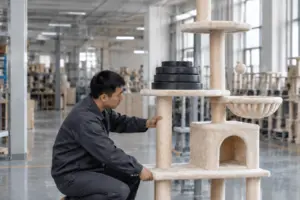
During production, the rope is wound around the post under tension, with each turn sitting closely against the previous one. Adhesive helps prevent movement, while staples or other mechanical fixing are commonly used at critical points, particularly at the beginning and end of the wrap.
The important part is not simply using more glue or more fasteners. It is keeping the rope under consistent tension as the post is wrapped.
If the tension is too low, gaps can begin to appear between the coils. Repeated scratching can enlarge those gaps, and sections of rope may start to rotate or slide down the post. Once a cat’s claws can catch underneath individual coils, the wrap can loosen even faster.
In our production experience, insufficient winding tension is one of the most common manufacturing causes of later rope movement.
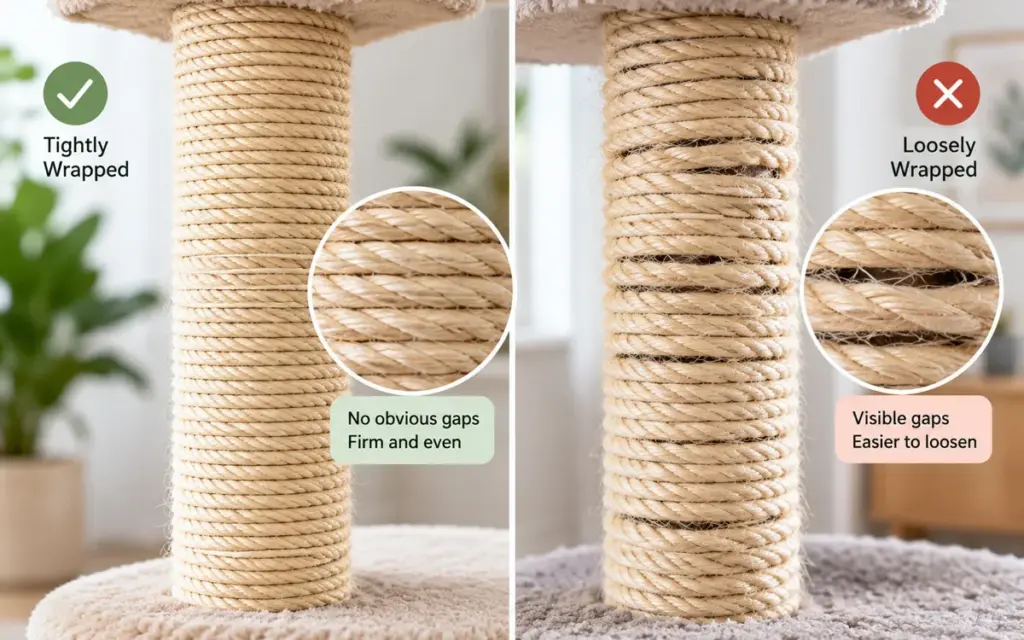
For a buyer, the manufacturing process translates into a few simple things that can be checked on a finished sisal post:
- The coils should sit closely together without obvious gaps.
- Individual sections should not move easily when pushed up or down by hand.
- The rope should feel firmly wrapped rather than loose around the core.
- The beginning and end of the wrap should be securely finished, without an exposed loose end that can easily be pulled out.
Two products may both state “8 mm natural sisal rope” on their specification sheets while the finished scratching surfaces behave very differently. How the rope is wrapped and fixed is part of the product quality.
Fraying Is Normal. Sliding and Detachment Are Not
A sisal post that gets scratched will eventually look worn. That does not necessarily mean the material has failed.
Normal wear usually starts with surface fuzziness. Individual fibers become rough, some break, and frequently used areas begin to look less tidy than the rest of the post. This is expected when claws repeatedly pull against a natural fiber.
The more useful question is whether the rope is wearing while staying structurally in place.
A post can look heavily used while the rope remains tight against the core. That is very different from a wrap developing large gaps, sliding down the post, rotating freely, exposing the post core, or detaching in large sections.
From the production and complaint cases we have seen, the progression of a poorly secured wrap often looks more like this:
small gaps → local movement → downward sliding → larger loose sections → exposed core → detachment
When this happens unusually early in the product’s life, the cause may be related to winding tension, fixing, adhesive application, or the quality of the rope itself rather than normal scratching alone.
There is no useful universal rule such as “sisal should last X months.” A heavily used post in a multi-cat home and a lightly used post for one cat experience very different wear. The condition of the wrap is more informative than its age.
What to Look for When Choosing a Sisal Cat Tree
If durability matters, asking whether a cat tree uses sisal is only the starting point.
Look first at the rope itself. A firm, consistent rope with a tight twist and limited loose fiber is a better sign than a soft, uneven rope that is already heavily fuzzy before use.
Then look at the wrap. The coils should be close together, difficult to shift by hand, and securely finished at the ends. Visible gaps or sections that can already move around the post are more concerning than whether the rope is labeled 8 mm or 10 mm.
Finally, consider whether the specification makes sense for the product. Larger cats, larger posts, and products designed for heavier use may justify thicker rope or more scratching coverage, but increasing diameter alone is not a complete durability strategy.
When developing a more durable scratching surface, we normally look first at rope quality, wrapping and fixing, scratching coverage, and post dimensions before automatically moving to a thicker rope. These decisions are part of the broader cat tree product development process, where material specifications need to work with the structure, target use, and cost of the whole product.
So instead of asking only:
“How thick is the rope?”
A better question is:
“Is the rope good enough, appropriate for the post, tightly wrapped, and securely fixed?”
Those factors together tell you much more about the likely performance of a sisal cat tree than the word “sisal” on a product listing.