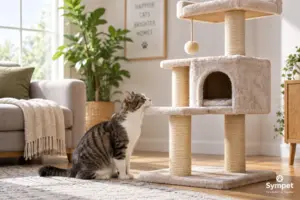
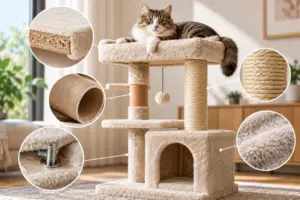
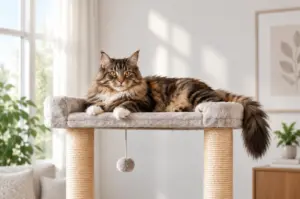
A good cat tree for older cats should reduce the effort required to reach useful resting areas. Look for an easy first entry, manageable transitions between levels, secure footing, stable platforms, and resting spaces large enough for the cat to settle comfortably.
That does not necessarily mean choosing the shortest cat tree available.
An older cat may still enjoy resting above the floor and observing its surroundings from an elevated position. The more useful question is whether the tree provides a route the cat can comfortably use now.
For some cats, that may mean lower platforms. For others, it may mean steps, ramps, or several intermediate levels leading gradually to a higher resting area. Cornell University’s guidance for senior cats similarly recommends using ramps or steps to help older cats reach places they previously jumped to.
When comparing products, look closely at the route shown in the product photos. A layout that requires a difficult first jump, leaves large gaps between useful levels, or places the most comfortable bed where the cat cannot easily reach it may be a poor choice even if the tree is marketed for older cats.
The goal is not necessarily to eliminate height, but to create an easier route to it.
Start With What Your Cat Can Comfortably Do Now
Age alone does not tell you which cat tree will work.
Two cats of the same age may have very different mobility, confidence, body size, and climbing habits. Instead of choosing according to an age label, watch how your cat currently moves through the home.
Does the cat hesitate before jumping onto a familiar surface? Does it use an intermediate object to reach somewhere it previously approached in one jump? Is climbing up easier than getting back down? Does it still seek elevated resting places but avoid routes that require larger movements?
Those observations provide more useful information than simply looking for a product marketed as a “senior cat tree.”
They also help define what the cat tree needs to do.
If the cat still wants elevation but prefers smaller movements, the priority becomes creating a sequence of accessible levels. If it spends more time resting, the accessibility and size of those resting areas may matter more than adding another high perch or play feature.
Changes in mobility can also have causes that a piece of furniture cannot address. Cornell notes that older cats can experience age-related health changes, including changes affecting mobility. If a cat develops significant or sudden difficulty jumping, climbing, walking, or using familiar spaces, discuss the change with a veterinarian rather than assuming it is simply normal aging.
Make the Route Easier, Not Just the Tree Shorter
Overall height is easy to compare, but it can be a poor measure of accessibility.
Imagine two cat trees.
The first is relatively short, but the cat must make a substantial jump from the floor to reach the first useful platform. The second is taller, but a low entry point leads to a series of intermediate platforms before reaching the upper resting area.
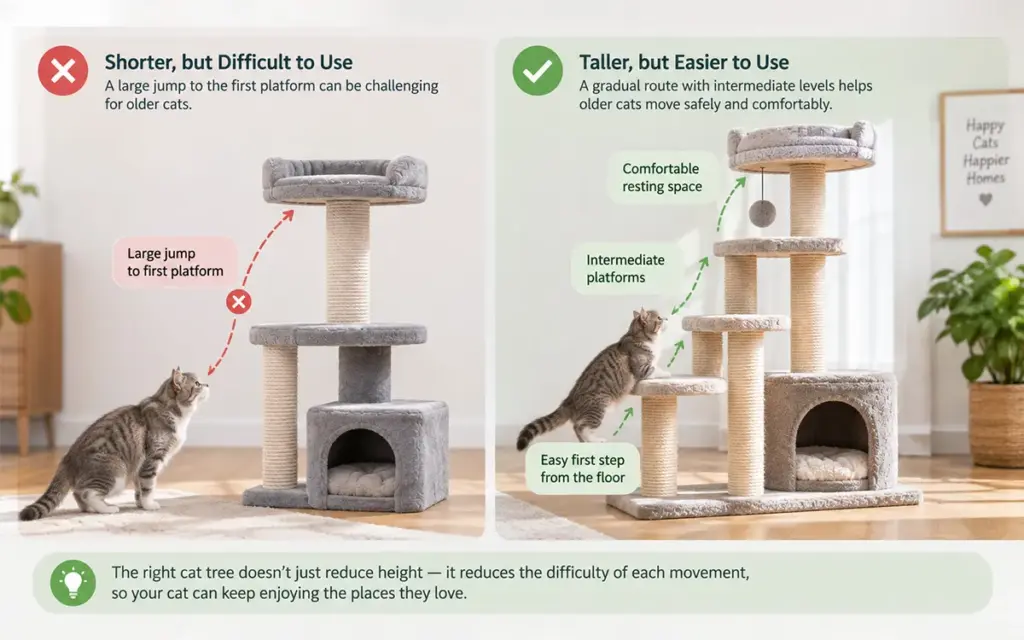
For an older cat with reduced jumping confidence, the taller structure may actually provide the easier route.
This is why accessibility should be evaluated through the entire climbing path.
Start at floor level. Identify the first place where the cat can put its paws and body securely. Then follow the route upward. Look at the position of each transition, the space available for landing, and whether the cat has to make awkward turns or large jumps to continue.
Then trace the route in reverse.
Getting onto a high perch is only half of the problem. The cat also needs a manageable way to return to the floor.
Steps and ramps can help in appropriate designs, but simply adding a ramp does not automatically make a cat tree accessible. Its position, surface, width, and connection to the next usable area all affect whether it creates a practical route.
For an older cat, the design goal is usually to reduce the difficulty of each movement—not necessarily the height of the final destination.
In other words, accessibility is a property of the route, not simply the overall height of the tree.
Check Footing, Platforms, and Stability Together
Making a platform easier to reach is not enough if the cat does not feel secure once it gets there.
An older cat moving more deliberately may benefit from surfaces that provide reliable footing rather than requiring it to recover from slipping or an unstable landing. Cornell’s senior-cat guidance similarly recommends easier access and non-slip surfaces for cats experiencing mobility changes.
Platform dimensions matter for a similar reason.
A platform can technically be large enough for the cat to stand on while still providing too little room to land comfortably, turn around, lie down, or get up again. What matters is the usable area after posts, raised edges, beds, and nearby components are taken into account.
From a product-development perspective, accessibility and stability should be reviewed together. Adding a larger platform, an intermediate step, or a ramp changes more than the climbing route—it can also change where the cat’s weight acts on the structure. A useful senior-friendly feature therefore needs to work both as an access point for the cat and as part of a stable support system.
A large platform, for example, can improve comfort, but its support still matters. If much of the usable area extends away from the supporting post or structure, movement can become more noticeable during use. Platform size, support position, and overall stability should therefore be considered together.
If you want to understand this relationship in more detail, our guide to sturdy cat trees explains how the base, supports, geometry, and connections work together.
For an older cat, the practical question is much simpler: when the cat steps onto a platform, turns, or moves toward the next level, does it have a predictable and secure surface under its feet?
Prioritize Resting Space Over Extra Features
Cat trees are often compared by counting features: houses, hammocks, toys, ladders, scratching posts, and platforms.
For an older cat, the number of features is less important than whether the most useful ones are comfortable and accessible.
A high padded bed has limited value if reaching it requires a difficult jump. A large enclosed house may look comfortable but be less useful if the entrance is awkwardly positioned relative to the climbing route. Likewise, an accessible platform may work well as a transition point without providing enough space for extended resting.
Think about the destination as well as the route.
If your cat likes sleeping in elevated places, look for a resting area it can reach without negotiating the most demanding movement on the tree. Check whether it has enough room to lie down, reposition, and get up again.
Scratching surfaces can still be useful, particularly when they are positioned along routes the cat naturally uses. But extra play accessories should not take priority over the basic functions of access, secure movement, and comfortable rest.
A simple cat tree with a well-designed route and several genuinely usable resting areas may therefore work better than a more elaborate structure filled with features the cat rarely reaches.
A route is only useful if it leads somewhere the cat actually wants to stay.
Use This Check Before Choosing a Cat Tree for Older Cats
Rather than searching for one feature that defines a senior-friendly cat tree, follow the structure from the floor to its most useful resting areas.
| Check | What to Ask |
|---|---|
| Entry | Can the cat reach the first useful level without a difficult jump? |
| Route | Can it move up and down in manageable stages? |
| Footing | Do the surfaces provide secure grip during transitions? |
| Landing & resting space | Is there enough usable room to land, turn, lie down, and get up again? |
| Stability | Do the platforms remain predictable and controlled as the cat moves? |
| Destination | Can the cat actually reach the places it is most likely to rest? |
There is no single height or layout that is right for every older cat. The appropriate design depends on the cat’s current mobility, size, habits, and the places it still wants to reach.
The best cat tree for older cats is therefore not automatically the shortest one. It is one that preserves useful vertical space while reducing the difficulty of getting there and providing secure, comfortable places to move and rest.