A carpet cat tree generally offers better grip, wear resistance, and easier cleaning, while plush feels softer and gives the tree a warmer, more comfortable appearance. Neither is universally better—the right choice depends on how the surface will be used.
For resting platforms and beds, softness may matter most. Landing and climbing areas benefit more from grip. Surfaces exposed to repeated wear need greater durability, while dedicated scratching areas are better handled by sisal rather than either upholstery material.
So instead of asking whether carpet or plush is simply “better,” it is more useful to ask what the cat needs to do on that surface.
Carpet and Plush Are Designed for Different Priorities
Carpet used on cat trees is typically relatively short and dense. Short cut-pile constructions are useful because they provide a firmer surface without adding excessive bulk around platforms and boards. They also reduce some of the snagging problems that can occur with looped or longer fibers.
Plush is different. Most modern plush-covered cat trees use polyester fabrics ranging from short pile to softer faux-fur-like finishes. The material compresses easily and creates the cozy surface commonly used on beds, platforms, and enclosed resting areas.
In the products we work with, polyester plush commonly falls around 300–420 gsm, although lighter and heavier specifications are also used depending on the target price and desired hand feel. Weight alone, however, does not determine durability or quality.
The physical difference is easy to feel.
Plush compresses under the paw and creates a softer resting surface. Carpet feels firmer and usually provides more traction when a cat lands on a platform or moves between levels.
For a quick comparison:
| Priority | Carpet | Plush |
|---|---|---|
| Softness | Moderate | High |
| Grip | High | Moderate |
| Everyday wear resistance | Generally better | More dependent on pile and quality |
| Hair and dust removal | Generally easier | Usually harder |
| Curves and complex shapes | More difficult to wrap | Easier to wrap |
| Cozy visual appearance | Moderate | High |
| Dedicated scratching | Not ideal | Not ideal |
The important distinction is that material specifications are not quality grades by themselves. A heavier plush is not automatically more durable, just as a carpet label alone tells you little about fiber construction, backing, installation, or long-term performance.
This is why cat tree materials should be evaluated by component function rather than appearance alone.
Carpet Usually Handles Wear Better
Cats do more than sleep on a cat tree. They jump onto platforms, push off between levels, knead resting areas, drag their claws across edges, and sometimes scratch surfaces that were never designed as scratching posts.
Carpet and plush respond differently to that repeated mechanical wear.
With carpet, fibers may gradually become fuzzy, pulled, or flattened. Heavily used areas can eventually wear through, and exposed edges may begin separating from the board underneath. With a suitable short cut-pile construction, however, the deterioration tends to be gradual.
Plush often shows wear through shedding, pilling, matting, thinning, or bald areas where the backing begins to show. Longer, fluffier materials can be particularly vulnerable when claws repeatedly pull at the fibers.
Edges can become another weak point. Once a plush edge begins separating from the substrate, repeated contact can progressively pull more material away.
In the cat-tree products we work with, a good short-pile carpet generally handles repeated wear better than ordinary plush of a comparable quality level.
That comparison still has an important limit.
Neither surface should be expected to perform like a dedicated scratching material. If cats are intended to scratch one area repeatedly, sisal is normally better suited to that function. Carpet may tolerate incidental scratching better than plush, but using upholstery as the main scratching surface asks the material to perform a job it was not primarily designed for.
Plush Is Softer, but Harder to Keep Clean
The reason plush remains common despite its wear limitations is straightforward: it feels comfortable and looks inviting.
Its soft pile works naturally on beds, hammocks, platforms, and enclosed cat houses. It also creates the warm, upholstered appearance consumers associate with a comfortable place for a cat to rest.
That visual effect matters in mainstream cat furniture, particularly for products sold online where buyers first evaluate the cat tree through photographs.
The trade-off becomes more noticeable during cleaning.
Loose hair, dust, dander, and small particles can work their way into plush fibers. Longer and softer piles make some of that debris difficult to remove completely with a vacuum. Liquids and stains can also penetrate into the fabric rather than remaining on a surface that can simply be wiped clean.
A recurring issue with heavily used plush surfaces is that they can gradually look dull or retain odors even with regular cleaning.
Short, dense carpet is generally somewhat easier to vacuum because hair is less likely to become deeply embedded in a fluffy pile. It is still a textile covering, however, so it will not clean as easily as exposed wood, another smooth surface, or a removable washable cushion.
The decision is therefore a trade-off.
Plush provides greater softness and visual comfort, while carpet can be easier to maintain over repeated use.
For a lightly used resting platform, plush may be entirely appropriate. For a high-contact surface in a multi-cat household, maintenance and wear resistance may deserve more weight.
The Surface Material Also Changes How a Cat Tree Is Made
The difference between carpet and plush starts before the cat ever uses the product.
Plush is soft and flexible, making it easier to conform around curved edges, enclosed cat houses, rounded beds, and irregularly shaped platforms. This makes it particularly useful on cat trees with multiple upholstered forms.
But that flexibility introduces manufacturing challenges.
Thin or low-density plush can reveal the board underneath or make staple locations more visible. Cut edges need to be folded and secured carefully, and poor tension during wrapping can create wrinkles or expose the backing.
Carpet is firmer and more structured.
On broad, flat platforms, that can help produce a clean surface. Around tight curves, internal corners, and small-radius edges, however, the same stiffness makes the material more difficult to fit without wrinkles or bulky transitions.
In typical production, both coverings can be secured using a combination of adhesive and staples. Adhesive keeps the main surface against the board, while staples reinforce edges, folds, and other critical areas.
Installation quality then becomes part of material performance.
With plush, poor wrapping or edge finishing can result in wrinkles, visible backing, exposed staple points, or edges that begin peeling away.
With carpet, poor fitting can create wrinkles around curved areas, raised edges, visible fastening points, or local areas where the covering no longer remains fully bonded to the board.
This is why two cat trees using apparently similar fabrics can age very differently.
Material specification and manufacturing quality work together. A more expensive covering cannot compensate for weak wrapping and fixing, while careful upholstery cannot completely compensate for a material that is poorly suited to the intended use.
Choose the Surface Around How the Cat Tree Will Be Used
The most useful way to choose between carpet and plush is not to select one covering for the entire cat tree.
Start with the function of each surface:
Resting surface → comfort
Landing and climbing surface → grip
Scratching surface → abrasion resistance
High-contact surface → durability and cleanability
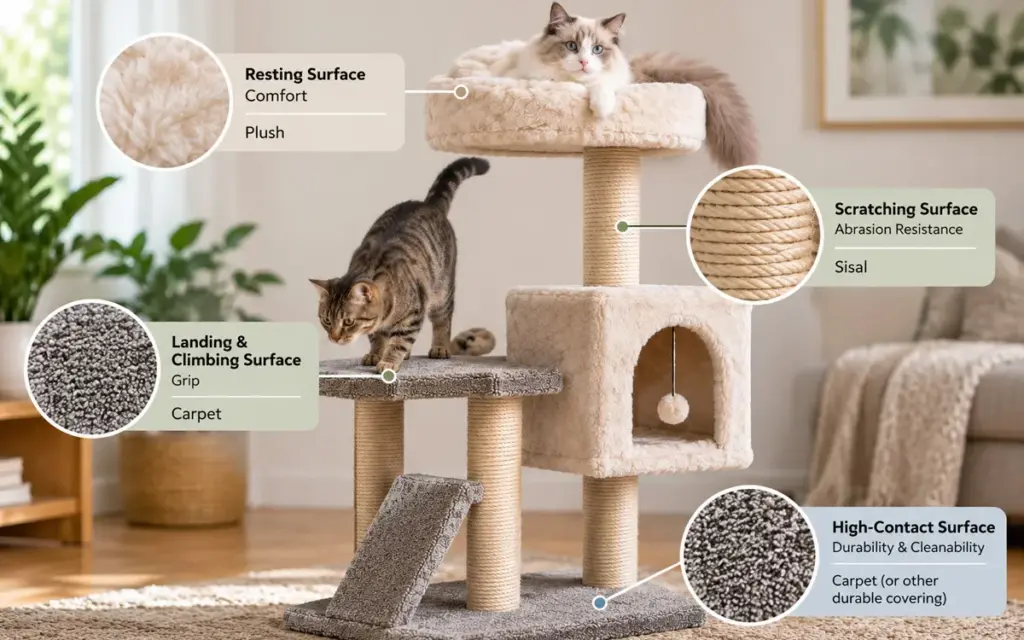
This gives a more useful product-development sequence:
Surface Function → Performance Requirement → Material Choice
For a sleeping platform or enclosed bed, plush can make sense because softness and comfort are important.
For areas exposed to more climbing, landing, and repeated contact, carpet may provide better grip and longer-lasting appearance.
For deliberate scratching, a sisal scratching surface should normally take over rather than relying on either upholstery material.
This often leads to a mixed-material cat tree rather than a simple carpet-versus-plush decision. A product might use plush where cats rest, a more durable covering in higher-wear areas, and sisal on dedicated scratching posts.
The commercial positioning matters as well. Plush works particularly well for mainstream products where softness, visual appeal, cost control, and complex upholstered shapes are important. Carpet becomes more attractive when durability, practical performance, grip, or large- and multi-cat use are stronger parts of the product requirement.
For brands developing cat furniture, surface selection should therefore be part of the broader product-development process rather than a cosmetic decision made after the structure is finished.
A better question than “carpet or plush?” is:
What should the cat do on this surface, and which material performs that job better?
Once that is defined, the material choice becomes much clearer.