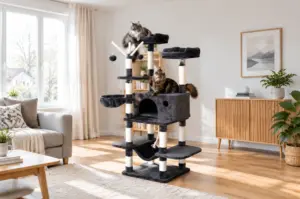
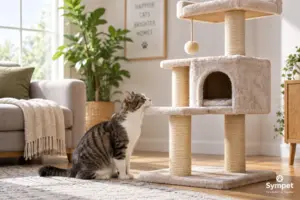
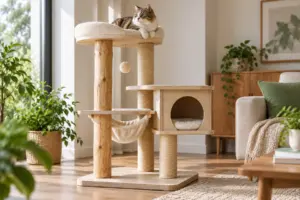
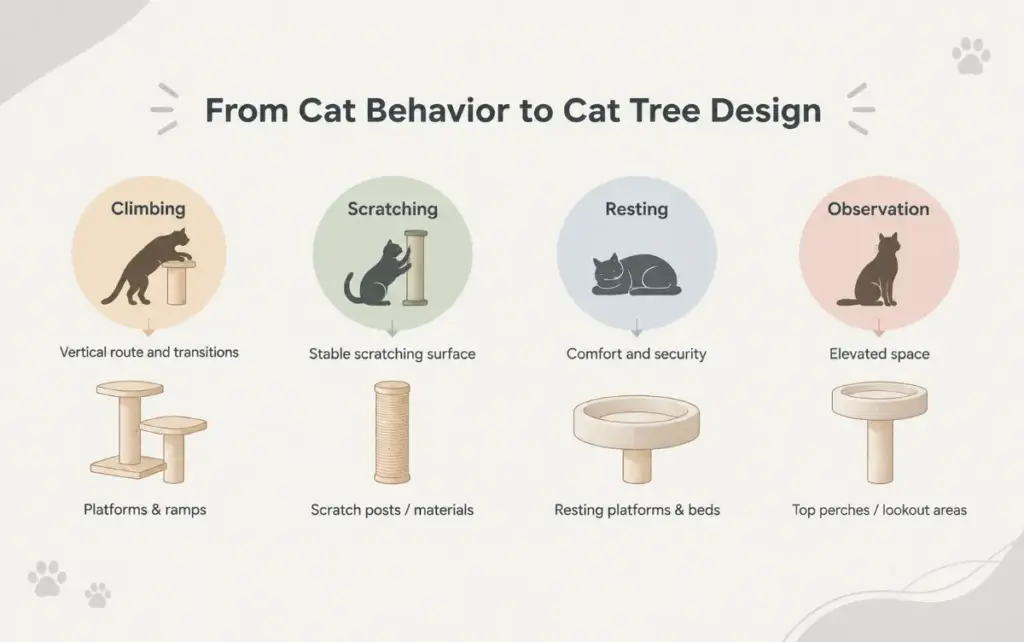
Cats do not need a cat tree to survive, but many indoor cats can benefit from having one. A well-designed cat tree provides dedicated space for natural behaviors such as climbing, scratching, resting, and observing the environment from an elevated position.
The value of a cat tree is not simply that it gives cats something to climb. A useful cat tree translates natural feline behaviors into a safe and comfortable structure designed for everyday use.
The important question is therefore not:
“Does every cat need a cat tree?”
It is:
“Does this cat tree provide the types of space and activities that match how my cat naturally behaves?”
When the design matches the cat, a cat tree becomes more than furniture. It becomes a place where cats can move, rest, explore, and interact with their environment.
Cats Do Not Need a Cat Tree, But They Do Need Space to Behave Naturally
Cats are adaptable animals, and many can live without a dedicated cat tree. However, indoor environments often provide fewer opportunities for climbing, scratching, and choosing different resting locations.
A cat tree is valuable because it creates a controlled environment where these behaviors can happen naturally.
Cats experience space differently from humans. A higher location can provide:
- a place to observe the room;
- a comfortable resting area;
- separation from activity at floor level;
- opportunities for climbing and movement.
This does not mean every cat prefers the tallest possible structure.
A useful cat tree is not defined only by height. It needs to provide accessible levels, comfortable resting areas, stable surfaces, and a layout that matches the cat using it.
For indoor cats especially, vertical space can add another dimension to their daily environment.
A cat tree is therefore not a replacement for natural behavior. It is a way of adapting the home environment so cats have more opportunities to express those behaviors.
Vertical Space Gives Indoor Cats More Ways to Use Their Environment
One of the biggest differences between human and feline perspectives is how space is used.
People usually consider floor area first. Cats often consider vertical territory as part of their usable environment.
A shelf, window area, furniture surface, or cat tree can all change how a cat interacts with a room.
However, simply making a structure taller does not automatically create better vertical space.
A functional vertical design needs:
- reachable transitions between levels;
- enough room to land and reposition;
- stable platforms;
- resting areas where the cat actually wants to spend time.
From a product-development perspective, height is only one part of the equation.
When designing cat furniture, we do not evaluate height separately. A taller structure changes the requirements for platform support, connection strength, and overall stability. The goal is not to maximize height, but to create a structure cats can use confidently.
This is why good cat furniture design focuses on the relationship between:
Height → Layout → Accessibility → Stability
A tall cat tree with poorly arranged platforms may provide less practical value than a smaller structure with a better climbing route.
Scratching, Climbing, and Resting Are Different Needs
A common mistake when evaluating cat trees is treating all features as interchangeable.
Cats use different parts of a cat tree for different purposes.
Scratching
Scratching is not simply about providing a scratching surface.
The surface needs to support the behavior it is designed for. Material, orientation, height, and stability all influence whether a cat chooses to use it.
A scratching post that moves when the cat pulls against it may be less attractive than one that feels secure.
Climbing
Climbing is about movement through the structure.
Cats need a route that allows them to move between levels naturally. Platform position, transition distance, and landing space all affect whether the structure feels comfortable to use.
A design with more platforms does not automatically create a better climbing experience.
Resting
Resting areas serve another purpose.
Cats often choose resting locations based on comfort, security, visibility, and accessibility.
A platform is more useful when the cat can comfortably lie down, change position, and return to it easily.
A well-designed cat tree therefore does not simply combine more features. It connects different functions into a structure that supports real behavior.
Choose a Cat Tree Based on Behavior, Not Features
Not every cat tree works equally well for every cat.
A young active cat may use a structure mainly for climbing and exploration. An older cat may value easier access and comfortable resting areas. A larger cat may require more usable platform space and stronger structural support.
This is why choosing a cat tree should start with the cat, not the product features.
Consider:
- How does the cat currently move?
- Does it enjoy climbing?
- Does it prefer elevated resting places?
- Does it scratch vertically or horizontally?
- Does it need more activity or more comfortable resting space?
- Will multiple cats share the structure?
From a product-development perspective, the process works in reverse:
Cat Behavior → Functional Requirement → Product Design
For example:
A cat that likes elevated resting areas requires more than height. It requires a stable route, suitable platforms, and a comfortable destination.
A cat that scratches frequently requires more than a scratching post. It requires an appropriate scratching surface positioned where the behavior naturally occurs.
The best cat furniture does not simply add features. It solves specific behavioral needs through design.
How to Decide If Your Cat Would Benefit From a Cat Tree
A cat tree may be especially useful if your cat:
- spends time looking for higher places;
- scratches furniture or other household surfaces;
- enjoys climbing and exploring;
- spends long periods indoors;
- needs additional resting areas;
- shares space with other cats and benefits from vertical separation.
However, the right choice depends on the individual cat.
Some cats may prefer lower structures, wider resting areas, or simpler designs. Others may actively seek height and more complex climbing routes.
The goal is not to choose the biggest or most complicated cat tree.
The goal is to provide a structure that supports the behaviors your cat already wants to perform.
A well-designed cat tree creates opportunities for climbing, scratching, resting, and observing while fitting naturally into the cat’s daily life.
Understanding these principles also helps when comparing different cat furniture designs, because the most valuable features are the ones that support real feline behavior.
If you are comparing different options, our guide to best cat trees explains the main factors to evaluate before choosing one.