A wood cat tree can sound like a clear upgrade from a conventional fabric-covered cat tree. But the word “wood” does not tell you exactly how the product is built—or whether it will actually be more stable or durable.
Many wooden cat trees use a combination of materials rather than solid wood throughout. Solid wood may be used for the posts, while platforms and bases are made from particle board or plywood. Fully solid-wood constructions also exist, but they are usually heavier, more expensive, and less common in mass-market products.
So is solid wood better?
It can offer real advantages, especially in screw holding, long-term connection performance, repairability, and natural appearance. But a well-designed particle-board or hybrid cat tree can still outperform a poorly designed solid-wood one.
The better question is not simply whether a cat tree is made of wood. It is where the wood is used, how the components are connected, and whether the construction fits the way the cat tree will be used.
What Does “Wood” Actually Mean in a Cat Tree?
When a product is described as a “wood cat tree” or “wooden cat tree,” it is easy to imagine that the entire structure is made from solid lumber.
That is not necessarily the case.
In the cat trees we work with, a common construction combines solid wood posts with particle-board or plywood platforms and bases. Other designs may use solid wood only in selected structural or visible components. Fully solid-wood products, where the posts, platforms, and base are all made from solid lumber, are possible but tend to sit in a more premium or specialized product segment.
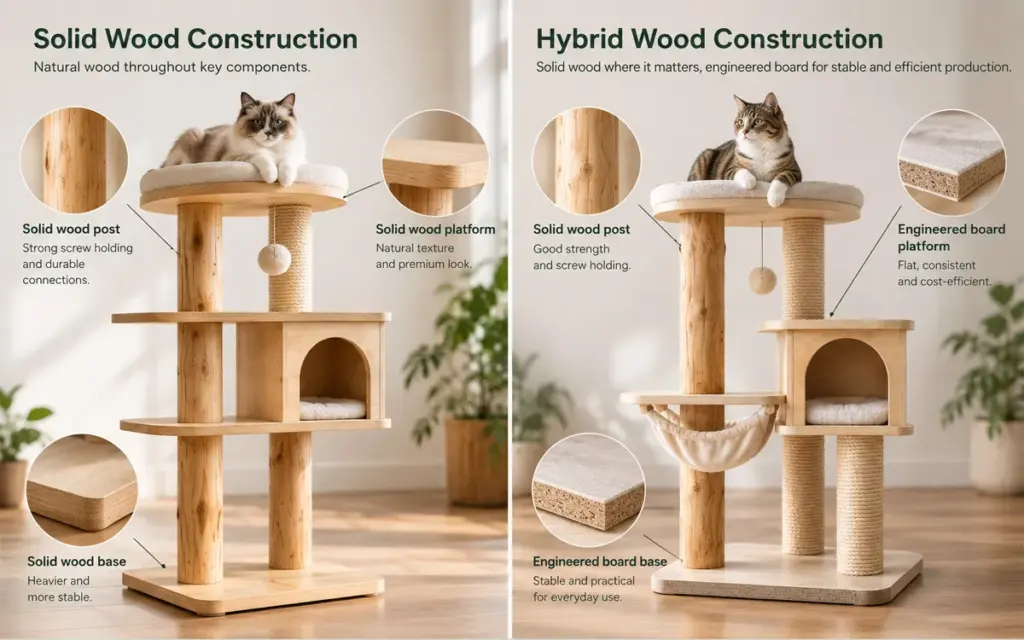
This mixed construction is not inherently a problem. Different components have different requirements.
A post needs to maintain its connections while receiving repeated movement and scratching forces. A large upholstered platform benefits from being flat, dimensionally consistent, and easy to cut accurately. A base needs enough size, stiffness, and weight to support the structure above it.
Using one material everywhere does not automatically produce the best result.
That is why the more useful question when evaluating a wooden cat tree is:
Which components are actually solid wood, and what materials are used for the rest of the structure?
The component breakdown tells you more than the word “wood” on the product listing.
Where Solid Wood Has a Real Advantage
One of the most useful advantages of solid wood in cat-tree construction is not simply that it looks more premium. It is how well it can perform around connections.
Cat trees experience repeated movement. Cats jump onto platforms, climb between levels, scratch posts, and push against the structure from different directions. Over time, these forces repeatedly load the points where posts, platforms, and hardware connect.
Solid wood generally provides stronger screw holding than particle board. If a connection begins to loosen, solid wood also gives more opportunity for tightening, repositioning, or repair.
Particle board behaves differently. Once the material around a heavily loaded screw hole begins to break down, the connection can become increasingly difficult to restore. With lower-density board, this can eventually appear as a loose platform or a connection that no longer tightens properly.
That does not mean particle board cannot support a cat tree. Appropriate board specification, connection design, and structural layout can all produce a durable product. The difference becomes more important when the same connection is exposed to repeated loads over a long period.
Solid wood can also provide good resistance to impact and localized damage, depending on the wood species and construction. Its natural weight may contribute to a more substantial structure, while exposed wood grain creates the furniture-like appearance many premium designs aim for.
Different woods behave differently as well. In the products we work with, rubberwood is a common choice for solid-wood posts because it offers a practical balance of hardness, machinability, appearance, and cost. Pine is lighter and more economical but softer, so exposed surfaces can show deeper claw marks. Harder woods such as beech may be selected when the product positioning and budget justify them.
The important distinction is that solid wood offers useful material properties; it does not guarantee a good cat tree design.
Why Particle Board Is Still Used in So Many Cat Trees
Particle board is sometimes treated as simply a cheaper substitute for “real” wood. That overlooks several reasons it works well in mass-produced cat furniture.
For platforms and bases, particle board provides a flat and consistent surface. It can be cut and drilled efficiently with CNC equipment, produced to standardized dimensions, and covered with plush, carpet, or other upholstery with good consistency.
It also makes product weight and cost easier to control—important for flat-packed cat trees where material choices affect packaging, warehousing, and shipping.
The board specification still matters. Thickness, density, connection design, and the structural role of each component all influence how the finished product performs.
This is why evaluating cat tree materials requires more than separating them into “premium” and “cheap” categories. A material should be judged according to the job it is being asked to perform.
For many mainstream household cat trees, properly specified particle board combined with sensible structural design is a rational manufacturing choice, not simply a compromise.
Solid Wood Has Its Own Failure Modes
Solid wood solves some problems, but it introduces others.
Wood is a natural material, which means moisture control matters. If lumber is not dried and conditioned properly before production, changes in temperature and humidity can contribute to warping or cracking later.
This can become especially relevant when products are manufactured in one climate and shipped or stored in another.
Natural variation also affects appearance. Color differences, grain variation, and knots are normal characteristics of wood, but consumers expecting perfectly identical components may interpret them as defects.
The wood species matters too. A softer material such as pine may be perfectly adequate structurally in the right design, but repeated scratching can leave deeper marks on exposed surfaces. Harder species may resist surface damage better, but they can also increase material and processing costs.
Manufacturing consistency is another consideration. Engineered boards arrive in predictable sheets that are easy to standardize for CNC production. Solid lumber requires more attention to individual pieces, machining, finishing, moisture, and appearance.
Poor material preparation can therefore undermine the advantages of solid wood.
A cat tree made from inadequately dried or poorly selected lumber is not automatically superior to one made from properly specified engineered board.
Choose the Construction, Not Just the Material Label
For a buyer, the choice between solid wood and particle board should start with how the cat tree will actually be used.
Solid wood becomes more attractive when long-term connection strength, repairability, natural appearance, or a more substantial construction is a priority. It can also make sense for large cats, multi-cat households, or premium product lines where the additional material weight and cost are acceptable.
Particle board remains practical for many conventional household cat trees, particularly when price, shipping weight, standardized production, and upholstered surfaces are important. With an appropriately sized base, sensible platform layout, suitable board specification, and secure connections, it can perform well in everyday use.
And the choice does not have to be one or the other.
In product development, we often use a hybrid approach: solid wood can be placed where its connection strength or structural properties provide the most value, while quality particle board is used for platforms and other components where flatness, consistency, cost, and manufacturing efficiency matter more.
A narrow solid-wood post cannot compensate for a base that is too small. Premium lumber cannot fix an excessively cantilevered platform. And a poorly designed connection can still loosen even when the surrounding material is strong.
The performance of a cat tree comes from the system:
Material + Structure + Connections + Base Design → Actual Performance
For brands developing cat furniture, this is also why material selection should be part of the broader cat tree product development process rather than a standalone specification decision. Target use, structure, materials, manufacturing, shipping, and price all need to work together.
So when comparing wood cat trees, do not stop at “solid wood” versus “particle board.” Look at what each component is made from, how the structure is connected, and whether those decisions make sense for the cats and the way the product will be used.
A well-designed hybrid or particle-board cat tree can be a better product than a poorly designed solid-wood one. The material matters, but the way it is used matters more.