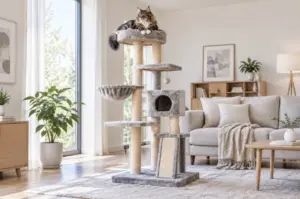
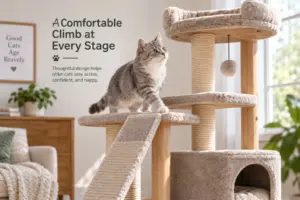
A good kitten cat tree should be easy to access, stable during energetic play, and laid out so a young cat can climb, land, scratch, and rest comfortably. Closely spaced, manageable transitions matter more than simply choosing the smallest tree.
It is also worth thinking beyond the first few months. A tree that works for a small kitten today may become cramped as the cat grows, so platform space, scratching areas, resting spots, and overall structure should be considered with adult size in mind.
Veterinary guidance supports giving kittens scratching surfaces and vertical space, while recommending that young kittens start with shorter cat trees as they learn to climb safely.
Choose for How a Kitten Moves
Kittens are still developing confidence and coordination. A cat tree should therefore make movement through the structure relatively straightforward rather than asking the kitten to negotiate awkward jumps between poorly positioned levels.
Look at the route from the floor upward. Can the kitten reach the first useful level easily? From there, are the next platforms positioned so there is somewhere clear to place the front paws, pull up, turn around, and continue climbing?
Coming down matters too.
A kitten may be willing to climb somewhere before it has learned an equally confident way back. This is one reason veterinary guidance recommends starting young kittens with shorter cat trees rather than immediately giving them access to the tallest structure available.
This makes the layout more important than the number of platforms.
A tree with many small levels can look feature-rich in a product photo while providing surprisingly little usable movement space. A simpler design with clear landing areas and logical transitions may work much better.
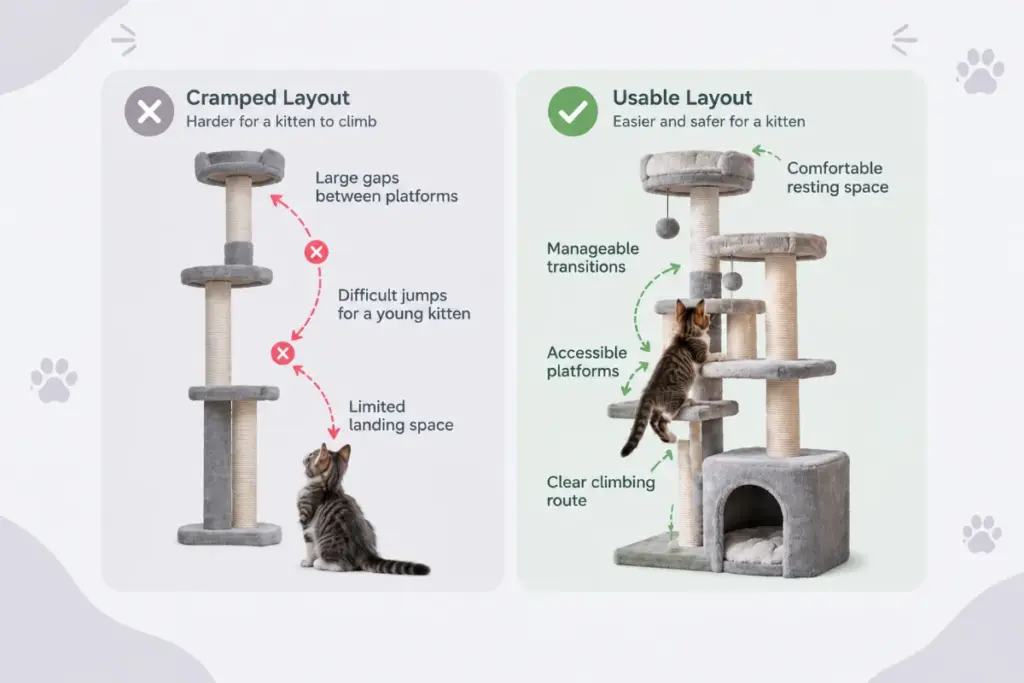
A kitten-friendly layout is not simply a smaller adult cat tree. The route through the structure matters.
Make Stability a Priority During Play
Because kittens are light, it is easy to assume that stability is less important for them. But body weight is only part of the use case.
Kittens climb, chase, jump, turn quickly, and may launch themselves toward toys or another level. These movements introduce forces in different directions rather than applying weight neatly downward onto one platform.
For that reason, evaluate the complete structure rather than one specification such as base weight.
A stable cat tree depends on how the base, support posts, platform positions, connections, and overall geometry work together. A wide or heavy base can help, but it cannot by itself correct excessive movement caused elsewhere in the structure.
Pay particular attention to upper platforms and components that extend a long way away from their supports. As the point where the cat applies force moves farther from the support, the structure has more leverage to control.
Connections matter as well. Movement at several individual joints may be small, but it can accumulate through a multi-level structure and become much more noticeable at the top.
If stability is one of your main concerns, our guide to sturdy cat trees explains these structural relationships in more detail.
Give the Kitten Places to Scratch, Play, and Rest
A kitten cat tree does not need the greatest possible number of toys and accessories. It needs features that support behaviors the kitten will actually use.
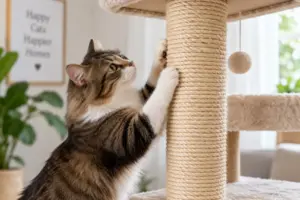
Scratching is one of them. Cats can differ in both the materials they prefer to scratch and whether they prefer vertical or horizontal surfaces. Cornell University’s Feline Health Center recommends matching scratching surfaces to these preferences and ensuring a scratching structure is sturdy during use.
A cat tree can combine this scratching function with climbing and elevated resting space. PetMD likewise notes that cat trees provide scratching surfaces and vertical places for cats and kittens to climb and sit.
But placement still matters.
A scratching post that is largely blocked by another component may provide less usable scratching area than its dimensions suggest. A small perch positioned at the end of a climbing route may technically count as a resting platform without giving the kitten much room to settle.
The same principle applies to play features. A hanging toy may attract attention, but it should not substitute for usable climbing, scratching, and resting space.
Instead of counting features, ask a simpler question:
What does this part of the cat tree allow the kitten to do?
If there is no useful answer, the feature may be adding complexity rather than value.
Think About What Happens as the Kitten Grows
Choosing only for the kitten’s current size can create another problem: cats grow much faster than cat furniture wears out.
A small platform that comfortably holds a young kitten may offer much less usable resting space later. An enclosed house can become difficult to enter or turn around in. A short scratching area may no longer allow a comfortable stretch.
This does not mean every kitten needs a large adult cat tree immediately. Accessibility and safe climbing still matter while the kitten is young.
The better approach is to evaluate both stages.
Look for a layout the kitten can use now while asking which major components will remain useful as the cat becomes larger and more capable. In some designs, lower levels provide easy early access while larger platforms and higher levels become more useful later.
Expected adult size matters especially when choosing for breeds likely to become substantially larger. In that situation, our guide to choosing a cat tree for large cats covers platform space, structure, and support in more depth.
The goal is not necessarily to buy the largest tree possible.
It is to avoid buying a structure whose most important features only work during a very short stage of the cat’s life.
Use This Check Before Choosing a Kitten Cat Tree
Before comparing colors, accessories, or the number of levels, work through the tree from the kitten’s point of view.
| Check | What to Ask |
|---|---|
| Access | Can the kitten reach and leave the important levels comfortably? |
| Landing space | Is there enough room to land, turn, and reposition? |
| Movement | Is there a clear route through the structure rather than a series of awkward jumps? |
| Stability | Do the base, supports, geometry, and connections control movement during active use? |
| Scratching & play | Are these features positioned where the kitten can actually use them? |
| Resting space | Are there comfortable places to settle, not just activity features? |
| Growth | Which parts of the tree will still be useful as the kitten becomes an adult? |
A good kitten cat tree therefore balances two requirements that can initially seem contradictory: it should be manageable for a young cat today without being designed only for a very small cat.
Choose for accessible movement and stability first, then look at scratching, resting, and play features, and finally ask whether the important parts of the structure will still make sense as the kitten grows.