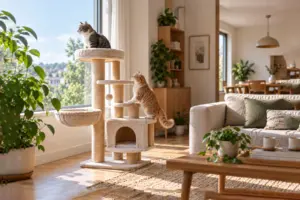
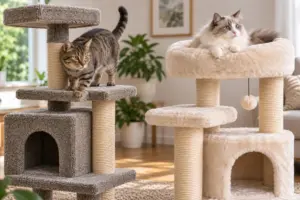
A sturdy cat tree is not defined by one specification such as base weight, board thickness, or post diameter. What matters is how the support area, structural geometry, connections, mass distribution, and any appropriate wall restraint work together when the assembled product is actually being used.
This is why comparing sturdy cat trees by weight or post thickness alone can be misleading. A heavy base or thick posts may contribute to stability, but neither proves that the structure will remain stable when a cat climbs, jumps, scratches, or moves across its upper levels.
For pet brands, retailers, and product buyers, the practical rule is simple: evaluate sturdiness and stability as properties of the complete assembled product—not from a list of impressive-looking component specifications.
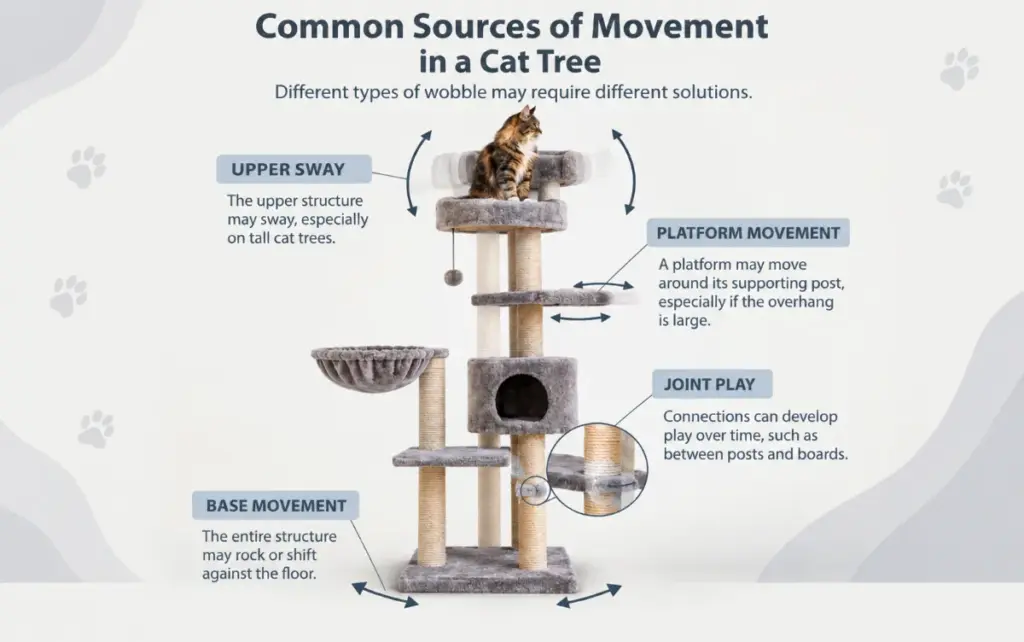
Why Does a Cat Tree Wobble?
When a cat tree wobbles, the first question should be: where is the movement coming from?
The entire structure may rock against the floor. The base may remain relatively stationary while the upper section sways. A platform may move around its supporting post, or a connection may develop play after repeated use.
These are different problems and may require different corrections.
Adding weight to the base may help a structure that tends to rock or tip, but it will not necessarily correct movement at an upper platform connection. Increasing post diameter may make one component more rigid without addressing an unfavorable support arrangement elsewhere.
For a buyer reviewing a sample, start by locating the movement:
- Does the base move relative to the floor?
- Does movement begin mainly in the upper structure or a particular platform?
- Is there visible play at a connection?
- Does movement or loosening increase with repeated use?
The objective is not simply to decide whether the product “feels sturdy.” It is to identify where movement begins and how it affects the assembled structure.
That gives the factory a specific product problem to solve rather than a vague request to “make it stronger.”
What Actually Makes a Cat Tree Sturdy and Stable?
A useful way to understand stability is through four connected elements:
The base establishes the support area. Geometry determines how platforms and loads are supported. Connections determine whether the components behave as one structure. Restraint can provide additional protection where appropriate.
The footprint and base create the foundation of the product. They become increasingly important as the structure gets taller or carries substantial occupied areas higher above the floor.
But a large or heavy base alone does not determine whether a cat tree is sturdy.
Support geometry matters because platforms need to transfer loads through posts and other structural components toward the base. A platform located close to its supports behaves differently from a large platform extending well beyond them.
Height and mass distribution also influence the assembled product. A tall cat tree with substantial components concentrated near the top can behave differently from a product of similar weight with more of its mass lower in the structure.
Connections then determine how effectively those components work together. Poor fit, loose hardware, or movement accumulating across several joints can make an otherwise substantial structure feel unstable.
An anti-tip restraint can provide additional protection where the product design, height, use conditions, or installation environment makes one appropriate. It should not be treated as a substitute for sound structural design.
These factors need to work together.
A heavier base cannot automatically compensate for poor support geometry, just as thicker posts cannot automatically compensate for weak connections.
This is also why cat tree weight capacity and stability are not the same specification. A component may support a particular vertical load while the complete structure still performs poorly when movement is introduced.
Why “Heavy Duty” Specifications Can Be Misleading
“Heavy duty” is a positioning term, not a technical definition.
The same caution applies when buyers compare supposedly sturdy cat trees primarily through isolated specifications such as board thickness, post diameter, or assembled weight.
Two suppliers may offer similar-height products with thick posts, substantial boards, and reinforced bases. Their assembled behavior can still differ because their platform positions, support arrangements, connections, and overall geometry are different.
Published manufacturer products illustrate this point. For example, Globlazer describes its S67 model with 110 mm support posts, a reinforced base, and an anti-tip restraint.
Those are manufacturer-reported specifications, not universal requirements for a sturdy cat tree. The useful point is that stability is being addressed through a combination of structural features, rather than one isolated number.
For sourcing teams, that leads to a more useful question:
Do not ask only whether a component is strong. Ask what structural problem that component is solving.
A larger post, thicker board, or heavier base may be justified. But each should follow from the intended structure and use case rather than being added simply to create a stronger-looking specification sheet.
This distinction affects commercial decisions as well. Adding material throughout a product can increase manufacturing cost, packaged weight, shipping requirements, and potentially packaging dimensions without necessarily fixing the source of instability.
The better approach is to identify the problem first and change the design accordingly.
How Should a Buyer Evaluate a Sturdy Cat Tree?
Stability evaluation can begin before the physical sample is available.
At the drawing or specification stage, review the overall height and footprint, major platform positions, support arrangement, significant overhangs, intended cat size and use, and whether wall restraint forms part of the installation strategy.
The goal is not to declare a drawing “stable.” It is to identify areas that deserve attention during prototyping.
Once a sample is assembled, check whether components seat correctly, hardware tightens as intended, and connections show obvious gaps, misalignment, or movement. Then observe how the complete structure behaves when movement is introduced.
A cat tree is not used as a static shelf. Cats climb it, jump onto platforms, pull against scratching surfaces, change direction, and launch from elevated positions.
For a product buyer, the evaluation can therefore be organized into three stages:
| Stage | What to Review |
|---|---|
| Drawing / specification | Height, footprint, platform position, overhang, support arrangement, intended use and restraint strategy |
| Assembly | Joint fit, hardware tightening, alignment and the source of any initial movement |
| Sample use | Base movement, upper-level sway, platform or joint movement, and loosening after repeated use |
This does not require inventing a universal test threshold.
Without a defined and validated test protocol, claims such as “apply X newtons of force” or “test at twice the cat’s body weight” create false precision. Test conditions need to match what is being evaluated and how the product is intended to be used.
The immediate objective is to make sample evaluation repeatable and diagnostic: identify where movement occurs, under what conditions it appears, and whether a design revision actually improves the product.
Define Stability Before the Factory Builds the Product
A request such as “make the base heavier” tells a factory what to change. It does not define the problem the product needs to solve.
A stronger product brief starts with the use case: intended cat size, number of cats, overall height and layout, major occupied platforms, expected movement, installation environment, and whether wall restraint is acceptable.
Those requirements can then be translated into product decisions:
Use Case → Geometry → Support Arrangement → Dimensions → Materials and Connections → Prototype → Evaluation
This sequence matters because stability should influence the structure from the beginning. It is much harder to correct unfavorable geometry by adding weight or material after the product has already been designed.
The same logic applies when revising an existing sample.
Instead of:
“Make it stronger.”
Feedback such as:
“The base remains stationary, but movement develops around this upper platform.”
gives the factory a defined problem. The support position, platform geometry, connection design, or another relevant variable can then be reviewed instead of increasing material indiscriminately.
For brands comparing or developing sturdy cat trees, the practical answer is therefore:
A sturdy cat tree is not simply the one with the heaviest base or thickest posts. It is one whose support area, geometry, connections, mass distribution, and restraint strategy work together for the intended cat and use case.
That is also how Sympet Living approaches cat furniture development: stability is treated as a product requirement to be translated into structure, prototyping, and sample evaluation—not as a “heavy duty” claim added after the product has been built.