Most cat trees are made from a combination of materials rather than one single material. A typical plush cat tree uses particle board or another engineered wood for the base and platforms, paper tubes or wood for the posts, sisal for scratching surfaces, plush or fabric for covering, and metal or plastic hardware to connect the structure.
If you’re trying to find the best material for a cat tree, there isn’t one material that is best for every part. A base, scratching post, platform, covering, and structural connection all perform different jobs and need different properties.
This also explains why two cat trees can both be described as “particle board, sisal, and plush” but perform very differently in actual use. Board thickness and density can differ. Platforms can have different support conditions. Sisal can be tightly or loosely wrapped. Connections can remain secure or gradually develop movement.
So the more useful question is not simply what material is this cat tree made from?
It is:
Is the right material being used in the right place for the job that part of the cat tree needs to perform?
A Cat Tree Is a Material System, Not a Single Material
A cat tree has to perform several functions at the same time.
The base supports the structure. Platforms carry the cat and create usable climbing and resting space. Posts support different levels and often provide scratching surfaces. Fabric covers exposed panels and affects comfort, grip, and appearance. Hardware connects these components into one structure.
That means even a relatively simple plush cat tree is usually a material system.
| Component | Common Materials | Main Function |
|---|---|---|
| Base and platforms | Particle board or other engineered wood | Structural panels and support |
| Post core | Paper tube or wood | Vertical support |
| Scratching surface | Sisal rope | Scratching and surface durability |
| Covering | Plush or other fabric | Comfort, grip, and appearance |
| Connections | Screws, inserts, threaded hardware | Joining structural components |
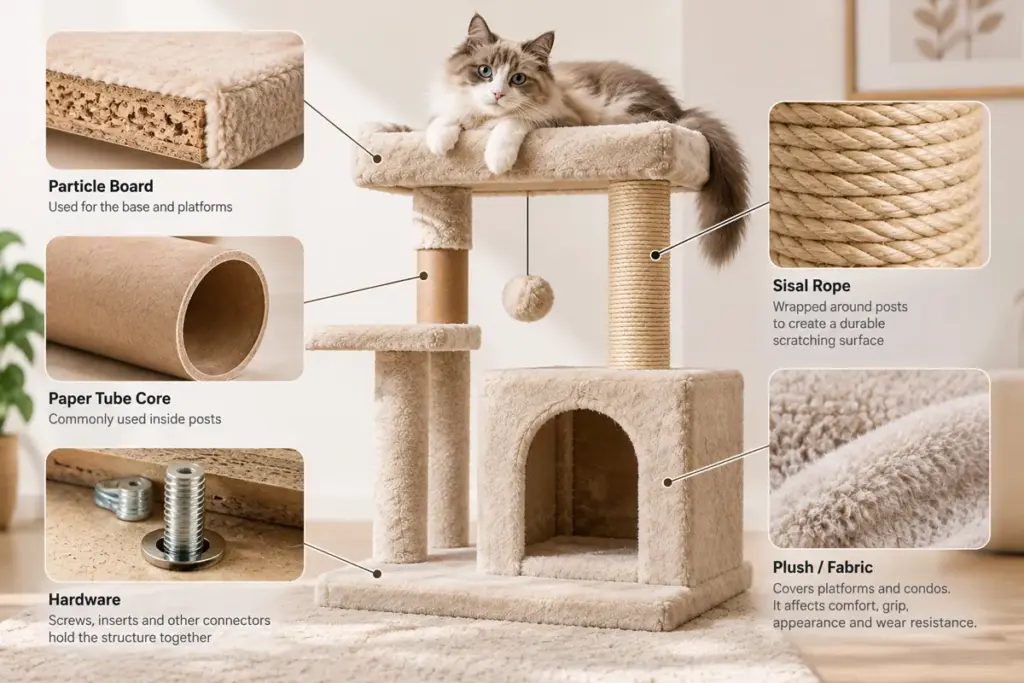
This is why comparisons such as “particle board versus solid wood” can be misleading when they are made without considering the rest of the product.
Solid wood can offer useful structural properties, but that does not mean every component needs to be solid wood. It also increases weight and cost.
Particle board, meanwhile, is widely used in mass-market cat furniture because it provides a practical balance between cost, machinability, weight, and repeatable production.
A better way to evaluate cat tree materials is to ask three questions:
What material is being used? Where is it being used? What does that component need to do?
Particle Board Can Work Well—If the Specification Fits the Structure
Particle board is one of the most common structural materials used for plush cat-tree bases and platforms.
It is also the material we most frequently encounter and specify in conventional cat-tree sourcing and development. It is economical, can be machined into consistent shapes at scale, and helps keep product weight under control.
But the words particle board do not tell you whether a cat tree is well built.
Particle board is not automatically a sign of a poor-quality cat tree. Its suitability depends on its specification and on how the panel is used within the structure.
In the products and factory specifications we work with, common board thicknesses include approximately 12 mm, 15 mm, and 18 mm.
Around 12 mm may be used for smaller or less structurally important components. We use it less frequently for larger load-bearing areas because a thin panel over a larger unsupported span can feel relatively flexible.
Around 15 mm is common for general platforms and medium-duty bases.
For larger platforms, bases, taller structures, or more demanding load-bearing positions, 18 mm may be more appropriate.
It is also normal to use different thicknesses within the same cat tree. A base may benefit from a heavier panel while a smaller, well-supported platform does not necessarily need the same specification.
Density matters too.
For better-quality applications, we may work with particle board around 650–700 kg/m³, where the denser material can provide more reliable screw holding and a more substantial structural panel. This is a practical range from our sourcing and product-development work, not a universal specification that every cat tree must meet.
For a buyer, the important point is that two products can both list “particle board” while using panels with quite different structural properties.
And even thickness and density are only part of the picture.
Platform size, distance between supports, overhang, connection position, and where the cat’s weight acts on the platform all influence how that panel behaves.
A thicker board cannot automatically compensate for poor structural geometry. A properly supported panel, on the other hand, can use its material much more effectively.
Material specification and structural design therefore need to be considered together.
Posts, Sisal, and Fabric Each Solve a Different Problem
The visible posts on a plush cat tree may look like a single component, but they often combine a structural core with a scratching or fabric surface.
Paper Tubes and Wood Posts
In high-volume plush cat trees, the core of a post is commonly a paper or cardboard tube.
Paper tubes are light, economical, and well suited to scalable production. Their lower weight also matters when a large cat tree has multiple posts and needs to be packed and shipped economically.
The ends of the tube can incorporate plastic or metal inserts that allow the post to connect to platforms using threaded hardware.
Solid-wood posts are another option.
We are more likely to consider them when developing heavier-duty products, designs for larger cats or multiple cats, or products positioned at a higher price point. Wood can provide stronger screw holding and greater resistance to deformation, but it also adds material cost and shipping weight.
That can make solid wood useful for certain products, but it does not mean a properly designed paper-tube post is unsuitable for a conventional cat tree.
The correct choice depends on the structure and intended use.
Sisal Rope
Sisal is commonly wrapped around posts to create a scratching surface.
In the products we work with, sisal rope is commonly around 6–10 mm in diameter, with approximately 8 mm frequently used for conventional scratching posts. Larger posts or some higher-positioned products may use thicker rope.
But thicker sisal does not automatically mean a better scratching post.
Installation matters.
A common manufacturing method is to apply adhesive while wrapping the sisal tightly around the post, with staples or small nails securing the ends and other critical points.
The rope needs to remain tight and consistent. Good sisal that is loosely wrapped can still become a poor scratching surface once repeated use begins pulling the winding apart.
For buyers, this means the visible rope itself is only part of what determines durability. The post underneath it and the way the rope is fixed matter too.
Plush and Fabric
Plush and other fabrics have a different role.
They influence appearance and softness, but they also affect grip, wear, shedding, and how the product feels after repeated use.
When evaluating fabrics for a cat-tree project, we consider factors such as hand feel, density, resistance to scratching and abrasion, pilling or shedding, colorfastness, relevant safety requirements, and cost.
The softest fabric is not necessarily the best choice.
A very loose plush can look comfortable in a product photograph but wear relatively quickly under repeated use. A denser surface may improve durability but produce a different appearance and feel.
The appropriate fabric therefore depends on the balance the product is trying to achieve between comfort, appearance, durability, and price.
Hardware and Connections Can Matter More Than the Material Name
Some of the most important materials in a cat tree are barely visible after assembly.
Platforms, bases, and posts only become a usable structure when their connections hold them together.
In conventional cat-tree construction, paper-tube posts often contain plastic or metal inserts at their ends. Screws or threaded hardware pass through the platform and engage with these inserts to lock the components together.
Other structures may use threaded rods, direct screws, metal brackets, or combinations of different connection methods.
These details matter because repeated movement does not act only on the board or post. It also acts on the joints between them.
If an insert is weak, poorly fitted, or begins moving inside a post, the structure can develop looseness even though the visible board, fabric, and sisal still appear undamaged.
The same principle applies to connections in engineered wood. Screw engagement, insert quality, board density, and joint geometry all affect how securely the parts remain connected.
A stronger material connected poorly can produce a weaker product than a more modest material connected correctly.
This becomes particularly noticeable in taller, multi-level designs. Small amounts of movement at several connections can accumulate into more visible movement near the top of the structure.
That is why evaluating sturdy cat trees involves more than looking for a heavy base or thick posts. The connections between those components are part of the stability system as well.
For buyers, hardware may be difficult to judge from a product photo, but looseness at joints, poorly secured posts, or repeated retightening after normal use can reveal as much about construction quality as the visible materials themselves.
Good Material Selection Starts With the Product Brief
In product development, the objective is rarely to use the strongest or most expensive material everywhere.
The objective is to specify materials that make sense for the product being created.
A high-volume entry-level cat tree has different requirements from premium cat furniture or a heavier-duty product designed for larger cats.
Target price sets an important boundary, but product size and intended use determine where structural material matters most.
A taller design or one with larger platforms may require changes to the base, board thickness, post dimensions, or connections. A product intended for large cats or multi-cat use may justify stronger posts, more substantial panels, improved inserts, or additional anti-tip considerations.
Appearance creates another set of requirements. A furniture-style wood finish needs a different material and surface strategy from a conventional plush cat tree.
Shipping also influences these decisions.
Increasing panel thickness, enlarging the base, replacing paper tubes with solid wood, or adding heavier structural components can increase product weight and sometimes package dimensions. Those changes eventually affect freight, fulfillment, and the price at which the finished product can realistically be sold.
This is why material development is a balancing process:
Target Market → Target Price → Use Case → Structure → Material Specification → Shipping
The goal is not to make every component as heavy as possible. It is to put material where it contributes to the intended performance of the product.
The same principle is useful when comparing cat trees as a buyer.
A heavier or more expensive cat tree is not automatically better. Instead, look at whether the material choices make sense for the size, layout, intended cats, and structural demands of the product.
If you are comparing complete designs rather than individual materials, our guide to best cat trees explains how usable space, layout, stability, construction, and features work together.
Ultimately, the best cat tree material is not one material.
Quality comes from choosing appropriate materials for each component and combining them with the right dimensions, support, and connections for the intended use.