If your cat is not using a cat tree, start by checking the tree and its location before trying to persuade the cat. Make sure the structure feels stable, the climbing route is accessible, the resting and scratching areas suit your cat, and the tree is placed somewhere your cat already wants to spend time. Then use play, treats, or familiar scents to encourage voluntary exploration rather than simply placing the cat on the tree.
This distinction matters because a cat that ignores a cat tree does not automatically need more encouragement. Sometimes the product or the environment needs to change first.
A cat may avoid a tree because it wobbles, the first platform is difficult to reach, the upper levels feel awkward to navigate, or the tree has been placed in an area the cat rarely uses. A new structure may also simply need time to become familiar.
Instead of starting with:
“How do I make my cat use this?”
Start with:
“What might be stopping my cat from wanting to use it?”
That question usually leads to a more useful solution.
First Find Out Why Your Cat Is Ignoring the Cat Tree
Cats can ignore a cat tree for different reasons, and those reasons do not all require the same response.
Start by observing what happens when your cat encounters the tree.
Does the cat avoid the area completely?
Does it approach and sniff the tree but never climb?
Does it use the lower scratching post but ignore the platforms?
Does it climb partway up and then turn around?
Does it reach a perch but rarely stay there?
These are different behaviors, and they can point toward different things to investigate.
A useful way to think about the problem is through four areas.
The Product
Look at the tree itself.
Does it move noticeably when the cat steps onto it? Is the first usable level easy to reach? Are the transitions between platforms practical for the cat’s size and mobility?
Also look at the areas the cat is expected to use rather than simply counting features. A perch can exist without providing enough usable resting space. A scratching post can be present without being positioned or surfaced in a way that interests that particular cat.
The Placement
A perfectly usable cat tree can still struggle in the wrong location.
If it is hidden in a room the cat rarely visits, offers little opportunity to observe the household, or is positioned so surrounding furniture interferes with access, changing the location may be more useful than adding more toys or treats.
Our guide to where to put a cat tree explains the relationship between cat behavior, room layout, and the structure itself in more detail.
Familiarity
A new cat tree is also a large unfamiliar object.
Different cats respond differently to changes in their environment. Some investigate immediately; others may take considerably longer before climbing or resting on something new.
Giving the cat time to approach and investigate without pressure can therefore be part of the process.
The Cat
Finally, consider the individual cat.
Age, body size, activity level, mobility, scratching preferences, and previous experience with vertical spaces can all influence how a cat responds to a particular design.
The goal is not to decide that the cat is “difficult.”
It is to identify where the relationship between the cat, product, and environment may not be working.
Check the Cat Tree and Its Location Before Encouraging Use
Before introducing treats, toys, or catnip, check whether the cat tree itself gives the cat a comfortable way to use it.
Start at floor level and follow the route a cat would actually take.
How does the cat reach the first platform? Can it move naturally from one level to another? Is there enough space to land, turn, and reposition? Does the structure remain stable as the cat moves through it? Are the most comfortable resting areas actually accessible?
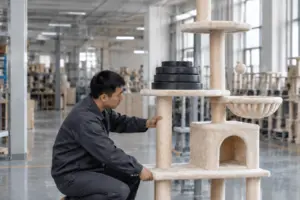
From a product-development perspective, reluctance can sometimes be useful feedback.
Imagine a cat willingly stepping onto the first platform but repeatedly stopping before the next one. Simply placing a treat on the highest perch does not explain why it stops.
Watching the point of hesitation may tell you where to look more closely.
The transition could be difficult. The next landing area may be awkward. Movement at that height may make the structure feel less secure. Or the upper area may simply offer nothing the cat currently values.
A hesitation is not proof of a design problem, but it tells you where to observe more closely.
The same principle applies when a cat scratches the bottom post but never climbs. One function of the product is clearly working even if the whole structure is not being used as intended.
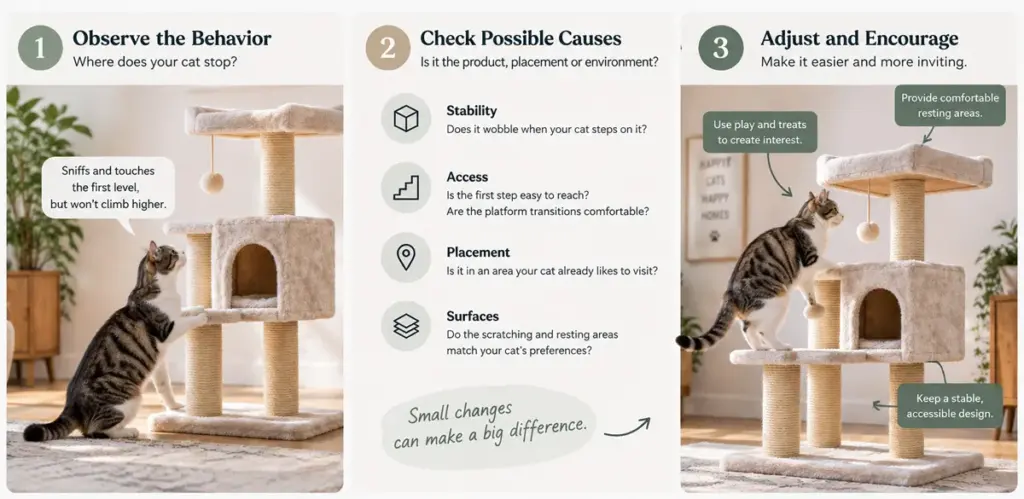
In product development, this is similar to evaluating a prototype through actual use. You do not only ask whether the product worked. You look for the point where the user hesitated, changed behavior, bypassed the intended route, or stopped using it.
A cat cannot explain that problem verbally, but its behavior can still reveal where to look.
Let the Cat Discover the Tree Voluntarily
Once the tree and its location appear suitable, give the cat an opportunity to explore it voluntarily.
Avoid repeatedly picking the cat up and placing it on the highest platform just to demonstrate where it should go.
Being physically placed somewhere is different from choosing to climb there.
The first goal is not to get the cat to the top.
It is to make the structure feel safe, familiar, and worth investigating.
That process can begin with very small interactions:
- approaching the base;
- sniffing the materials;
- scratching a lower post;
- putting front paws on the first level;
- stepping onto a low platform;
- resting there briefly.
Those behaviors may look insignificant compared with using the entire tree, but they are part of the cat learning how the structure fits into its environment.
Allowing the cat to control the pace also gives you better information. If the cat consistently explores one part while avoiding another, you can observe a real preference rather than a reaction to being placed there.
Use Play, Treats, and Familiar Scents to Build Interest
Once you have checked the product and placement, positive associations can help encourage exploration.
The important distinction is that these methods should reinforce a usable product, not compensate for one the cat finds uncomfortable or difficult to navigate.
Use Play to Create a Movement Route
A wand toy can be used to guide attention gradually through the structure.
Instead of immediately directing the toy toward the highest perch, begin around the base or first platform.
The progression might look like:
Floor → Base → Lower Platform → Next Level
This allows climbing to become part of play rather than a separate task the cat is expected to understand immediately.
It also gives you another opportunity to observe movement. If the cat enthusiastically follows the toy until one particular transition and then stops, inspect that part of the structure more closely.
Use Treats as Small Rewards
Treats can reward approaching or exploring the cat tree.
Start close to the structure or on an easily accessible level rather than placing the reward somewhere the cat must make an uncomfortable jump to reach.
As the cat becomes more comfortable, rewards can gradually move farther into the structure.
The purpose is to build a positive association, not to force a difficult movement because food is waiting at the other end.
Add Something Familiar
A familiar toy or blanket on a resting platform may make a new structure feel less unfamiliar.
Catnip can also interest some cats, but it should not be treated as a universal solution. Cats do not all respond to it in the same way.
The principle is simple:
Attraction can encourage exploration, but it cannot fix poor access, instability, or an unsuitable layout.
If Your Cat Still Will Not Use It, Reassess the Product
If your cat remains uninterested after having time to become familiar with the tree, do not assume that adding more treats, toys, or catnip will eventually solve the problem.
Go back to what the cat is actually doing.
| What You Observe | What to Check |
|---|---|
| Cat approaches but will not climb | First step, entry height, stability, or initial transition |
| Cat uses only the lower levels | Upper climbing route, platform transitions, or confidence higher in the structure |
| Cat skips the intended route and jumps directly to another platform | Whether the designed transitions are actually useful |
| Cat climbs but does not rest | Perch size, comfort, location, or value of the resting area |
| Cat scratches furniture instead | Scratching material, orientation, position, or placement |
| Older cat no longer reaches favorite levels | Accessibility, transitions, and changing mobility needs |
This is where choosing the right cat tree in the first place matters.
A product with more platforms, greater height, or more features is not automatically a better match. What matters is whether the usable dimensions, movement route, stability, scratching areas, and resting spaces fit the cat that will actually use it.
If reassessing the current tree shows that the basic design is a poor match, our guide to best cat trees explains what to compare before choosing another structure.
There is also an important distinction between a cat that has never shown interest in a particular cat tree and a cat whose behavior suddenly changes.
If a cat that previously climbed and jumped normally becomes noticeably reluctant to do so—especially if you also notice other changes in movement or behavior—the cat tree may not be the only factor worth considering. In that situation, discussing the change with a veterinarian may be appropriate.
For most cat-tree problems, however, the useful sequence is straightforward:
Check the Product → Check the Placement → Build Familiarity → Encourage Voluntary Use
Getting a cat to use a cat tree is not simply about making the tree more attractive.
First make sure the cat, product, and environment are a good match. Then give the cat a reason—and enough time—to choose the structure for itself.