The best cat tree is one that fits your cat’s size, age, and behavior while providing usable climbing and resting space, stable support during movement, and construction that can withstand repeated use. Height, price, weight, or the number of platforms alone does not make one cat tree better than another.
A practical way to compare cat trees is to look at them in this order: fit the tree to the cat, check the space the cat can actually use, consider how the cat will move through the layout, evaluate stability and construction, and only then compare extra features.
That approach matters because many of the differences that affect everyday use are difficult to see in a product title or specification table. Two cat trees of similar height can provide very different usable space. Two models made from similar materials can feel very different once assembled. And a product that looks substantial in a photograph may still have platforms, transitions, or upper sections that do not work well for the cat using it.
Start With the Cat, Not the Cat Tree
Before comparing products, define what the cat actually needs from one.
Body size is an obvious starting point. A larger cat needs enough room to turn around, settle into a resting position, and move between levels without constantly negotiating undersized surfaces. If you are choosing for a bigger breed or heavier adult cat, our guide to choosing a cat tree for large cats goes deeper into these dimensions.
Age and mobility change the requirement as well. A young, active cat may use height, vertical transitions, and climbing routes extensively. An older cat may still value elevated resting places but benefit from easier transitions between levels.
The number of cats also matters. A structure used by two or three cats is not simply carrying more total weight. Multiple cats may occupy different levels at the same time, share a large platform, pass each other on the structure, or jump onto it from different directions.
Scratching behavior is another part of the decision. Cats vary in the surfaces and orientations they prefer for scratching, so the location, height, orientation, and covering of a scratching area can matter as much as simply having one.
This gives you a better starting specification:
Who will use the tree, how will they use it, and which parts of the structure will they actually depend on?
Once that is clear, comparing products becomes much easier.
Look at the Space the Cat Can Actually Use
Overall dimensions tell you how much room a cat tree occupies. They do not tell you how much useful space it gives the cat.
Consider an upper platform that looks large in a specification drawing. Part of that area may be occupied by a support post, raised rim, nearby house, or another component. What remains is the usable area where the cat can actually stand, turn, stretch, or lie down.
The same principle applies to the whole layout.
Look at the tree as a route rather than a collection of components. Can the cat move naturally from one level to another? Is there enough room to land on the next platform? Can a larger cat enter the house comfortably? Does reaching the highest perch require an awkward turn or jump?
This is why counting platforms is rarely enough. Five cramped levels can offer less practical value than three well-proportioned ones.
For product evaluation, we find it more useful to consider the cat moving through the structure rather than posing on it. That simple change in perspective often reveals problems that are difficult to notice in a product photograph.
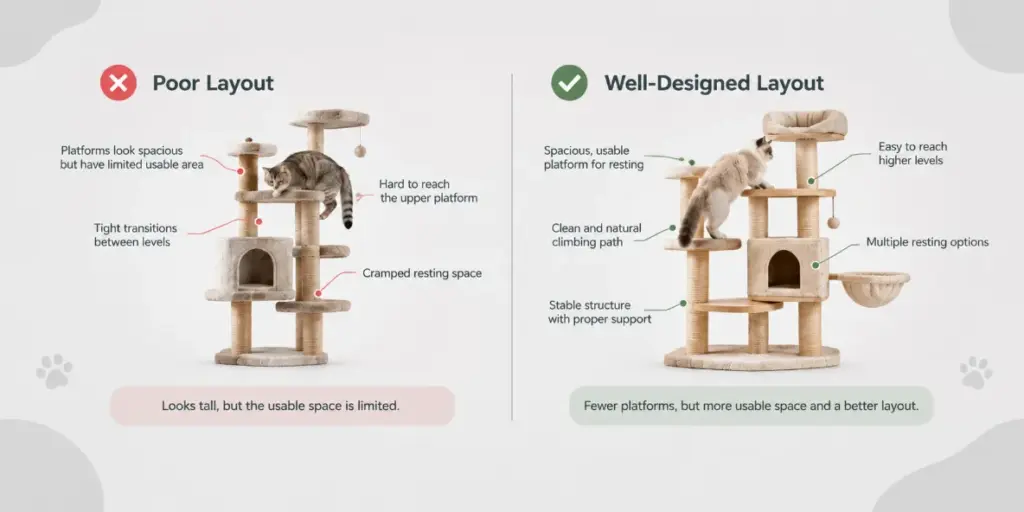
A good layout therefore balances vertical space with surfaces the cat can genuinely use. Height is valuable when the rest of the design makes that height accessible.
Check Stability Before Comparing Extra Features
Once the tree fits the cat and the layout works, look at how the structure is supported.
A useful starting point is the relationship between the base, posts, platforms, connections, and upper structure. These components work together. Evaluating only one of them can be misleading.
A heavy base, for example, can improve stability, but base weight alone cannot correct every problem higher in the structure. A large platform positioned far from its support creates different structural demands from the same platform positioned closer to a post. Loose connections can also introduce movement even when the individual components appear substantial.
This becomes more important as cat trees become taller or their upper platforms become larger.
When we evaluate a cat tree structure, we look at where the cat’s weight is likely to act, how that load is transferred through the supports, and where movement can accumulate through the assembled product. This gives a much better picture than relying on labels such as “stable” or “heavy duty.”
For a deeper explanation, see what makes sturdy cat trees stable in practice.
Weight ratings should also be interpreted carefully. A whole-tree capacity, individual platform capacity, and the load created when more than one cat shares a component are different questions. Our guide to cat tree weight capacity explains how to evaluate those claims in more detail.
The practical buying question is therefore not simply:
How heavy is the cat tree?
It is:
How well does the complete structure control movement when the cat climbs, jumps, rests, and changes position?
That is much closer to what the cat will actually experience.
Judge Materials by Where and How They Are Used
Material names are useful, but they become meaningful only when considered as part of the construction.
A cat tree contains components performing very different jobs. Structural panels support loads. Posts transfer forces through the tree. Scratching surfaces need appropriate texture and durability. Fabrics and plush coverings affect comfort, appearance, cleaning, and wear. Hardware keeps separate components working as one assembled structure.
For that reason, asking whether one material is simply “better” than another can lead to the wrong conclusion.
Take an engineered wood platform as an example. Its performance depends not only on the material label but also on factors such as thickness, dimensions, unsupported span, support position, and the way connections engage with the panel.
The same logic applies elsewhere. A scratching material should be judged by how and where the cat can use it. A post should be considered together with its height, connections, and structural role. Hardware should be evaluated as part of the joint rather than as an isolated specification.
This is particularly useful when comparing cat trees at different price points. A longer materials list or a premium-sounding material does not automatically mean the complete product has been designed better.
Instead, ask:
- Is the material appropriate for what this component needs to do?
- Is there enough material where strength or durability matters?
- Is the component adequately supported?
- Are the connections appropriate for repeated assembly and use?
- Can high-wear surfaces be maintained or replaced if necessary?
That shifts the comparison from material names to how the product is actually built.
Use a Simple Check Before You Choose
Once you understand the individual factors, choosing among the best cat trees becomes much simpler. Evaluate each option in the same order.
| Check | What to Ask |
|---|---|
| Fit | Does it suit the cat’s size, age, activity level, and number of users? |
| Space | Are the platforms, houses, and resting areas actually large enough to use comfortably? |
| Movement | Can the cat climb and transition between levels naturally? |
| Stability | Do the base, supports, geometry, and connections work together to control movement? |
| Construction | Are the materials and joints appropriate for their actual structural or wear requirements? |
| Features | Which hammocks, houses, scratching areas, toys, or aesthetic details add useful value? |
This order also helps prevent attractive secondary features from dominating the decision too early.
A hammock is useful only if the cat can reach and use it comfortably. An extra-tall design is useful only if its upper levels remain accessible and stable. A large house adds little value if the intended cat cannot enter, turn around, or rest comfortably inside it.
For brands and product developers, the same framework works in reverse during cat furniture product development. Define the intended cat and use case first, translate those needs into dimensions and layout, establish structural and material requirements, and then validate the assembled sample before finalizing secondary features.
The best cat tree is therefore not necessarily the tallest, heaviest, or most complicated option. It is the one in which fit, usable space, movement, stability, and construction work together for the cat that will actually use it.