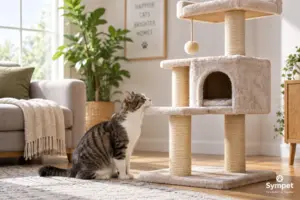
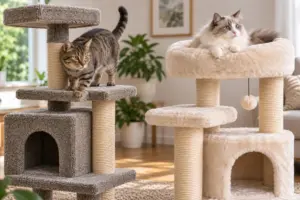
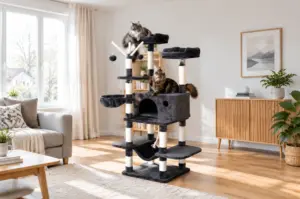
A small cat tree should save floor space without making the parts your cat actually uses too small.
That distinction matters. A compact cat tree is not necessarily a short cat tree, and simply shrinking the base, platforms, posts, and overall structure rarely produces a better product.
The real challenge is fitting useful climbing, scratching, and resting space into a smaller footprint while keeping the structure stable enough for normal jumping and movement.
In the compact cat trees we develop, the footprint is usually the first constraint we work around. Heights and features come afterward.
That leads to a more useful way to think about small cat trees:
Compact Cat Tree = Small Footprint + Usable Cat Space + Essential Functions + Controlled Stability
The best design is therefore not the one that makes every dimension smaller. It is the one that uses limited space more efficiently.
A Small Cat Tree Should Save Floor Space, Not Just Be Short
When people describe a cat tree as “small,” they may be talking about several different things.
It might have a small base. It might be relatively short. It might fit into a corner. Or it might simply look less bulky than a conventional multi-level cat tower.
For small apartments and rooms where floor area is limited, footprint is usually the more useful starting point.
In compact products we have worked with, very small footprints may fall around 35 × 35 cm to 40 × 40 cm, while 40 × 40 cm to 45 × 45 cm is a more common working range for compact apartment-oriented designs. Some products can extend toward 50 × 50 cm and still remain relatively space-efficient.
These are working examples rather than universal size standards. The right footprint depends on the cat, the height of the structure, platform dimensions, and how the weight is distributed.
Height has to be considered differently.
Many compact products we develop stay roughly within 80–120 cm, although some designs can extend higher. But making a small-footprint tree progressively taller creates a structural trade-off: the center of gravity rises while the base available to resist movement remains limited.
This is why “small” and “short” should not be treated as the same product requirement.
A compact cat tree can still use vertical space efficiently. The goal is to gain useful height without creating more structure than the base can comfortably support.
In practice, that means the design often needs fewer, better-positioned features rather than simply more levels.
What Should a Compact Cat Tree Keep?
Limited space forces priorities.
A large cat tree can accommodate multiple beds, platforms, tunnels, hammocks, toys, ramps, and scratching surfaces. Trying to preserve all of those features on a much smaller base usually creates clutter rather than function.
For compact designs, we normally prioritize three things:
a useful elevated perch, a proper scratching surface, and a comfortable place to rest or hide.
The top perch matters because height itself is useful to cats. Even when the overall structure is smaller, an elevated resting point gives the cat somewhere to observe the room.
Scratching also should not become an afterthought. At least one useful section of sisal-covered post is generally more valuable than several short scratching areas interrupted by platforms or decorative features.
A resting area might be an open platform, padded bed, or small condo depending on the product. What matters is that the usable area remains appropriate for the intended cat rather than being reduced simply to make the product photograph look compact.
When space becomes tight, features such as hammocks, extra intermediate platforms, tunnels, ramps, multiple enclosed condos, and excessive hanging toys are usually easier to remove.
The underlying priority is simple:
Climb → Scratch → Rest High
Everything else has to justify the space and structural complexity it adds.
This matters because every additional platform is not free. It adds weight, changes the center of gravity, creates another connection point, and may require the platform to extend farther outside the base.
A compact cat tree often becomes better when unnecessary functions are removed rather than compressed.
[RELATED_PRODUCT]
A Smaller Footprint Makes Stability Harder
Reducing the base creates one of the main structural problems in compact cat trees.
The smaller the footprint becomes, the less room the structure has to manage weight and lateral movement.
The most common problem we encounter is a combination of a high center of gravity and excessive platform overhang.
Imagine a relatively narrow base with a large top perch extending well beyond it. The perch may look comfortable, but when a cat lands near its outer edge, that movement creates leverage against the entire structure.
If the base is light, the board is too thin, or the post arrangement does not control that force effectively, the tree can sway or one side of the base can begin to lift.
This creates an important compact-design trade-off:
Smaller Footprint → Less Stability Margin → Greater Need to Control Height, Overhang, Weight Distribution and Connections
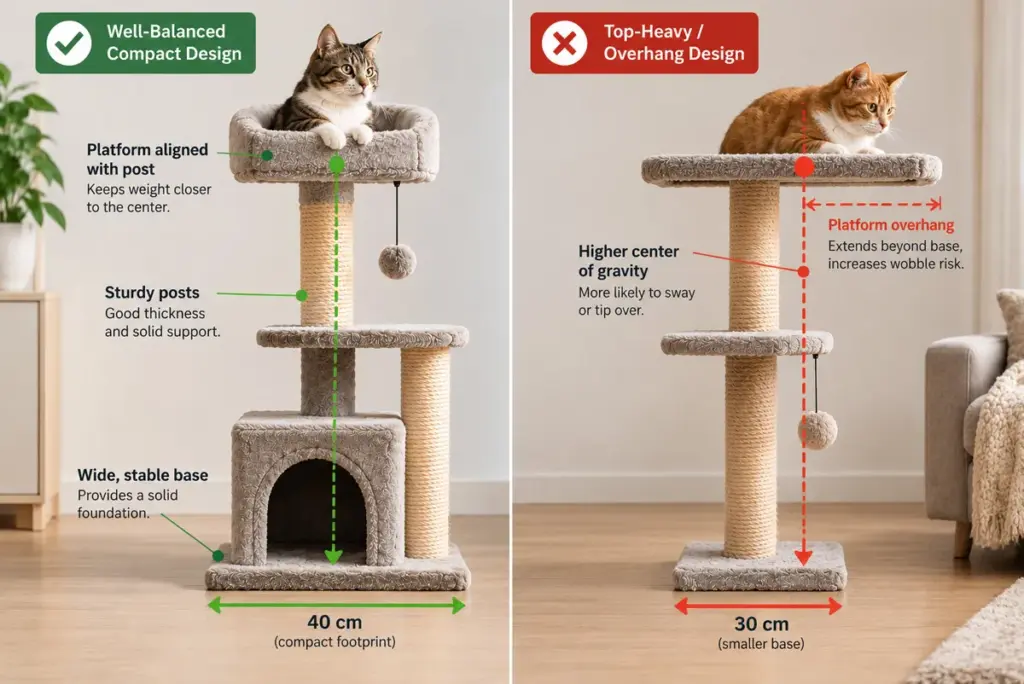
Simply making the posts thinner to save space does not solve the problem either. Narrow or insufficiently supported posts can allow more lateral movement, while a structure relying heavily on a single post concentrates repeated forces through fewer connection points.
The same applies to the base. Reducing board thickness or using lower-density material to make the product lighter can work against the stability the smaller footprint already needs.
Better compact designs therefore tend to control several variables together: keep major platforms reasonably close to the supporting posts, avoid unnecessary overhang, use enough base mass and stiffness, and keep the upper layout from becoming disproportionately heavy.
The same factors also matter when evaluating sturdy cat trees, especially as height and loading increase. An appropriate anti-tip restraint can provide another layer of protection, particularly as the structure becomes taller.
The important point is that compactness has a structural cost. Floor space can be reduced, but the design has to compensate somewhere else.
Corner Cat Trees Save Space, but They Are Not Always the Better Design
A corner cat tree sounds like an obvious solution for a small room.
Sometimes it is.
Triangular or fan-shaped bases can fit into unused corners and make a cat tree feel less intrusive in the room. For someone who knows exactly where the product will be placed, this can be an effective use of otherwise awkward space.
But a corner shape does not automatically make the structure more efficient.
A triangular base distributes material and weight differently from a conventional square base. Although placing the product against two walls can help limit movement in some directions, the structure can still be more sensitive to movement away from the corner or across its diagonal.
Platform design also becomes more complicated.
Cats do not land according to the shape of the furniture. A fan-shaped or asymmetric platform still needs enough usable landing area, and its relationship to the posts below affects how force moves through the structure.
Poorly positioned platforms can create both awkward landing areas and an unbalanced upper structure.
There are manufacturing trade-offs as well. Irregular board shapes can create more offcut waste during cutting, while unusual platform geometries add complexity to upholstery and assembly. A product with a triangular footprint may also still require a relatively conventional rectangular shipping carton, reducing some of the packaging advantage its shape appears to offer.
For these reasons, we do not treat a corner structure as the default answer to limited space.
Often, a compact square-base cat tree placed near a wall or in a corner provides a better balance of space efficiency, structural predictability, manufacturing efficiency, and placement flexibility.
A true corner design makes the most sense when fitting that specific location is an important part of the product requirement.
Choose the Footprint Around the Cat Before Adding More Features
The best small cat tree starts with two questions:
How much floor space is actually available?
How large and active is the cat that will use it?
Those two answers determine how much freedom remains for height and features.
For a small or medium cat in an apartment, a compact footprint can still support useful vertical climbing, scratching, and elevated resting space if the structure remains reasonably balanced.
The trade-offs become more important when choosing cat trees for large cats.
A larger cat needs a perch or platform with enough usable area to sit, turn, and rest comfortably. In compact products we have developed for larger cats, platform dimensions around 35–40 cm have sometimes been used as a practical starting point, depending on the platform shape and intended use.
But place a platform of that size on a 40–45 cm base and there is little room left to manage its position. As platform size and height increase, the stability margin of a compact structure becomes smaller.
That is why a compact cat tree for a larger cat usually needs compromises elsewhere. Height may need to come down. The base may need more weight or stiffness. Posts may need to become more substantial or use additional support, and platforms need to stay closer to the structural center.
For demanding applications, an anti-tip restraint becomes particularly important.
Trying to combine the smallest possible footprint, large platforms, maximum height, multiple features, and high stability in one product usually creates conflicting requirements.
This is also how we approach compact cat trees during product development. When a customer asks for a model for small apartments, we do not begin by adding features to a smaller drawing.
The sequence is closer to:
Available Footprint → Cat Size → Height → Must-Have Functions → Stability
Retail positioning, material choices, and packaging requirements then determine how that structure can be turned into a viable product.
The principle is equally useful when choosing one for a home.
Do not ask only whether the cat tree is small enough to fit the room. Ask whether the space it occupies is being used for the functions your cat actually needs.
A good small cat tree does not make everything smaller.
It makes limited space work harder.