floor-to-ceiling cat tree is usually the better choice when you want more vertical climbing space without giving up much floor area. A tall freestanding cat tree is usually easier to place, move, and keep stable without depending on the ceiling.
The important difference is not simply height. It is how each design creates stability.
A freestanding cat tree has to control movement through its own base, weight, structure, and connections. A floor-to-ceiling model uses tension between the floor and ceiling, allowing it to stay relatively narrow while extending much higher.
That can work extremely well in the right room. But it also means the ceiling height, floor surface, installation quality, and tension system become part of the product’s performance.
So the better choice depends on your space, your cats, and how much installation and maintenance you are willing to accept.
Floor-to-Ceiling Cat Trees Save Space, but Depend on the Room
The main advantage of a floor-to-ceiling cat tree is vertical space with a small footprint.
Instead of relying on a wide, heavy base to resist movement, most designs extend a post upward until a tension mechanism presses against the ceiling. Platforms, beds, and climbing steps can then be arranged vertically along that structure.
This makes the format particularly useful in apartments and smaller rooms where a conventional tall cat tree might occupy too much floor space.
Most floor-to-ceiling designs we have worked with use a spring-loaded tension rod. A telescoping metal or plastic rod compresses an internal spring, creating upward pressure against the ceiling. Threaded adjustment systems are also used, although spring-loaded designs are common because they can simplify installation.
At the top, a round or square contact pad normally distributes pressure against the ceiling. Rubber, textured anti-slip material, foam, or another soft covering may be used to improve grip and reduce marking.
But this also reveals the fundamental limitation of the design:
The room becomes part of the structural system.
A floor-to-ceiling cat tree only works properly when the ceiling height falls within its adjustment range and both contact surfaces can maintain adequate pressure.
In floor-to-ceiling products we have worked with, adjustment ranges around 2.3–2.7 m or 2.4–2.9 m are practical examples used to cover common residential ceiling heights. The actual range varies by product and target market. Extending the range is also not automatically better: adding more extension sections introduces more joints, which can create additional movement in a tall structure.
Ceiling and floor conditions matter just as much as height. Sloped ceilings can create uneven contact. Suspended or soft ceilings may deform under pressure. Thick carpet or compressible flooring can gradually settle after installation and reduce the tension that originally held the tree firmly in place.
For this type of cat tree, checking the room is therefore just as important as checking the dimensions of the product.
Which Is More Stable? The Answer Depends on How Stability Is Created
It is tempting to assume that a cat tree touching the ceiling must be more stable than one standing on the floor.
That is not necessarily true.
The two designs create stability in fundamentally different ways.
For a tall freestanding cat tree, stability depends mainly on:
Base Width + Base Weight + Structure + Connections + Anti-Tip Restraint
For a floor-to-ceiling design, the system changes:
Floor Support + Post Stiffness + Tension + Ceiling Contact + Installation
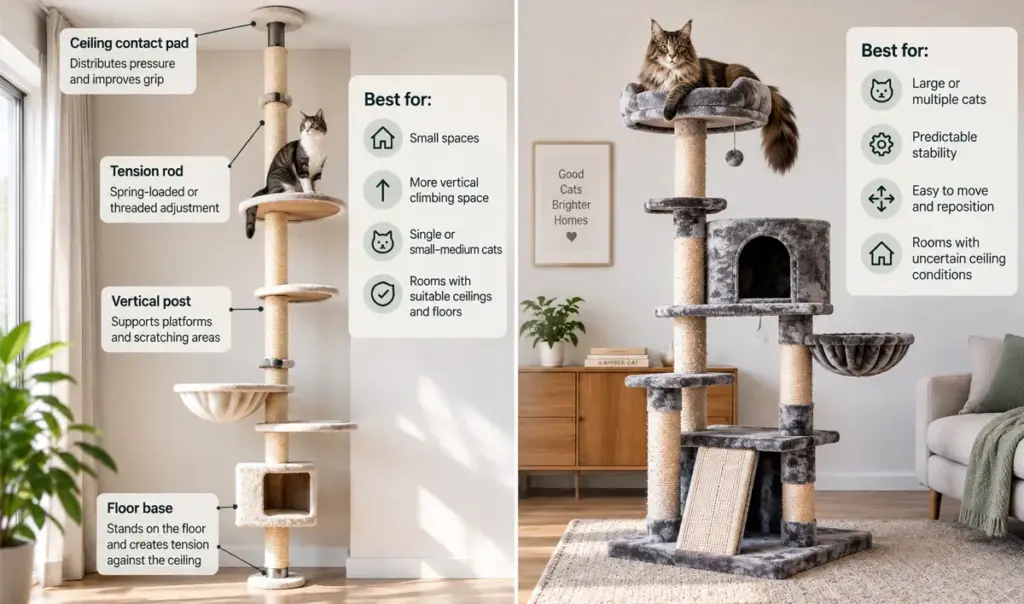
A well-designed tension-mounted cat tree can be extremely stable. A strong spring, sufficiently stiff post, reliable connections, suitable ceiling and floor surfaces, and correct installation allow the ceiling to help resist the lateral forces created when a cat jumps between platforms.
This can provide very good stability without requiring a large base.
But a tension-mounted structure also introduces variables that the product itself cannot completely control. A thin rod can flex, a weak spring may provide insufficient tension, and a ceiling contact pad can move if the contact surface does not provide enough grip.
A wide-base freestanding tree works differently. Its base dimensions, weight distribution, post positions, platform overhangs, connections, and anti-tip system can all be designed as part of the product itself.
When predictable stability across different rooms matters most, a well-designed wide-base freestanding tree with an anti-tip restraint is therefore usually easier to control. In product development, we also tend to see fewer installation variables with this structure than with an ordinary tension-mounted design.
That does not make floor-to-ceiling designs inherently unstable. A high-quality tension system using a thicker rod, stronger spring, reliable connections, and suitable contact surfaces can perform very well.
The difference is where the stability comes from.
Floor-to-Ceiling Cat Trees Need More Installation and Maintenance
With a tension-mounted cat tree, installation is not simply an assembly step. It creates the force that helps keep the upper structure stable.
That force may need to be checked again later.
For example, carpet or another soft floor covering can compress after the cat tree has been standing on it for some time. A contact pad may settle slightly, and repeated use can expose an installation that was not sufficiently tight in the first place.
A useful way to think about the process is:
Initial Installation → Surface Settlement → Tension Loss → Increased Sway → Re-tightening
Periodic tension checks are therefore sensible for this type of structure.
Installation itself can also be less convenient than the product’s slim appearance suggests. One person may need to align the structure vertically, compress or adjust the tension mechanism, position the ceiling pad, and keep the platforms correctly oriented at the same time.
Problems become more likely when the actual ceiling height sits very close to the minimum or maximum adjustment limit.
Floor-to-ceiling designs can also be poor matches for certain rooms, including:
- sloped or angled ceilings;
- suspended or lightweight ceilings that cannot accept sustained pressure;
- soft ceiling finishes that may deform;
- ceilings outside the specified adjustment range;
- thick carpet or highly compressible flooring that makes tension difficult to maintain.
There is a cosmetic consideration as well. A ceiling contact pad can leave a pressure mark after extended use, while a pad that moves under lateral force may mark or scratch the surface.
This is particularly relevant for renters. No drilling does not necessarily mean no surface impact.
A tall freestanding cat tree avoids most ceiling-related compatibility issues and is easier to reposition. It still needs correct assembly and, particularly at greater heights, an appropriate anti-tip solution, but its basic stability does not need to be recreated through ceiling tension.
For Large Cats and Multiple Cats, Freestanding Is Usually Easier to Control
When choosing cat trees for large cats such as Maine Coons, or for a multi-cat household, a wide and appropriately weighted tall freestanding cat tree with an anti-tip restraint is usually the more predictable starting point.
The reason is dynamic movement rather than body weight alone.
A large cat jumping onto an elevated platform creates lateral force. Multiple cats climbing, jumping, and changing positions can repeatedly shift loads through different parts of the structure.
If a tension-mounted system remains correctly installed, it can resist those forces effectively. But if tension has decreased, repeated lateral loading can make movement more noticeable.
That affects more than structural performance. A cat that feels the tower move significantly when landing may become reluctant to use the upper levels.
A freestanding design allows more of these variables to be addressed directly through a wider and heavier base, stronger posts and connections, controlled platform overhang, appropriate weight distribution, and an anti-tip restraint.
Floor-to-ceiling designs are not automatically unsuitable for large cats. A model built around a stiff, larger-diameter post, strong tension system, reliable connections, and suitable installation conditions can still work well.
But the margin for poor installation or lost tension becomes more important as the expected use becomes more demanding.
For a single small or medium cat in an apartment where floor space is limited, that trade-off may be completely reasonable. For several large cats using the structure intensively, controlling stability through a substantial freestanding structure is often simpler and more predictable.
Choose the Structure Around the Room, the Cat, and the Product
Neither design is universally better. The better starting point depends on the conditions in which the cat tree will actually be used.
| Your Situation | Better Starting Point |
|---|---|
| Small apartment or limited floor space | Floor-to-ceiling |
| Single small or medium cat | Floor-to-ceiling can work well |
| Large cat or multi-cat household | Tall freestanding |
| Sloped, suspended, soft, or uncertain ceiling | Tall freestanding |
| Thick carpet or compressible flooring | Tall freestanding is easier to manage |
| Need to move or reposition the tree regularly | Tall freestanding |
| Suitable ceiling and floor, with periodic tension checks acceptable | Floor-to-ceiling |
From a product-development perspective, the distinction follows the same logic. A freestanding design can control stability mainly through its base, post layout, connections, weight distribution, and anti-tip system. In a floor-to-ceiling design, ceiling range and tension-system reliability become primary structural requirements much earlier in development.
This creates two useful ways of thinking about tall cat trees:
Freestanding Stability = Product-Controlled Stability
Floor-to-Ceiling Stability = Product + Installation-Environment Stability
A floor-to-ceiling cat tree should therefore not be chosen simply because it looks slimmer or reaches higher. Its real advantage is providing substantial vertical territory from a small footprint—but that advantage only works when the room can support the tension system properly.
The better design is the one whose stability system matches the cat, the space, and the way the product will actually be installed and maintained.